
Categories
Business & Society

At the Turning Point, What Comes Next?

We have reached a pivotal moment – a turning point – in the evolution of digital currencies. The questions on everyone’s mind are: what comes next and what does it mean?

We've seen the rise and fall of crypto hype, starting with the ICO boom in 2017, followed by a wild bull run in 2021. But chaos reigned in 2022 and 2023 due to fraud and lack of regulation. Europe stepped up with stronger regulations, and countries in Asia and the Middle East grew a liking to crypto. The global cryptocurrency adoption rate is 15 %. Now, in May 2024, crypto is a hot political topic in the US as both parties want the young votes who like cryptocurrency. Meanwhile Scandinavia is sleeping on the issue with only 8% adoption level.

What is next for crypto?

I would say that we are now moving into stable growth and widespread adoption. Sure, we will still speculate in Jenner and Joe Boden tokens.

Fun fact: Caitlyn Jenner launched 12 different meme coins on Solana over 4 days, buying the tokens herself and then selling them for profit… ”I see you Caitlyn, its all on the blockchain.”

But the talk of the town is tokenization. Everything physical will be made digital and tradable. EVERYTHING! With the Ethereum Spot ETF in the U.S., it is clear that the cryptocurrency space is increasingly seen as a productive investment. Blackrock has launched tokenized treasury funds called BUILD with a $375 million market cap and the tokenization race is just starting.

Cryptocurrency is maturing as a consequence of increased regulation, institutional involvement, and technological advancements and integrated into the broader economy. A sign of the maturity of the crypto space is the fact that it will be focusing even more on creating lasting value and utility.

The transition from speculative chaos to a more mature and stable industry is never smooth. There will be challenges and setbacks along the way. Hear me say further scams, rug-pulls, and frauds just like in traditional finance.

Crypto will still attract those looking for get-rich schemes and money will be lost as the average newbie will buy at the top and sell at the bottom. There, in the not-too-distant future, I see clearer regulation, ease of use of crypto, broader adoption globally, and cryptocurrency will be a new playground for Wall Street and traditional finance players.

Let’s not kid ourselves. Traditional finance does not care that Bitcoin is decentralized. The wet dream of cryptocurrency being a separate asset away from the greedy and controlling hands of traditional finance is over.

Hey! It’s about the money. Not financial equality. We need to see that this tiny asset class ($2.68 trillion) is about to be gobbled up by its arch-nemesis. Banks will not go away. CBDC’s are a fact in the next few years and banks are already using blockchain technology and cryptocurrencies in their services.

It’s a love-hate relationship between tradfi and defi, but still a marriage.

Categories
Business & Society

The Philosophical Evolution of Money in Scandinavia: From Viking Assets to Digital Trust

From the days of the Vikings to the modern digital age, people's understanding and use of currency have transformed over centuries. The way we relate to money is closely linked to our needs and wants. The journey of money in Scandinavia reveals an interesting story of philosophical change among the population.

In the brutal Viking Age, Scandinavians engaged in trade primarily through bartering goods and utilizing silver as a form of currency. Hum, they raped and pillaged as well. During this time people relied on the intrinsic worth of goods and money reflected a strong belief in the physical value of assets.

The 11th century brought a big change when coins were introduced, influenced by foreigners. This marked a major shift towards using standardized currency, showing that people were starting to accept a common way to trade goods. It’s clear that standardization grew important for people’s financial lives and the next step in the evolution of money was taken.

As Scandinavia progressed into the 17th and 18th centuries, the establishment of central banks in Denmark, Sweden, and Norway signaled another philosophical transition. People started to trust the government more when they began using paper money issued by the government. This showed a shift away from relying on valuable metals like silver and gold, towards trusting the government to control and back the currency.

But they soon realized that we should not just print money.

The late 19th century witnessed the creation of the Scandinavian Monetary Union, uniting Denmark, Sweden, and Norway under a common gold-backed currency known as the krona/krone. This action emphasized the common belief that money should be tied to real assets like gold to maintain stability and worth. An action to hinder the limitless printing of money which leads to inflation.

But by the mid-20th century, Scandinavia and the rest of the western world embarked on another philosophical journey as it transitioned from gold-backed money to fiat currency. Now central banks could print limitless amount of paper money again. Without having to back it up with gold.

Today, the Danish krone, Swedish krona, and Norwegian krone stand as national fiat currencies, is the strongest sign of the faith placed in governmental regulation and oversight. Trust in government ability to manage the economy has clearly increased in Scandinavia since the age of the Vikings.

I would say that nowadays the reliance on government-backed currency has reached a tipping point. Because no philosophical extreme has all the answers.

The rise of cryptocurrency symbolizes a move towards trusting technology away from centralized control to protect the value of our currency. I believe in a society that holds different philosophical values of money. History shows that we need central banks for clarity and regulation and cryptocurrency is the modern solution for the needs and wants of people who value financial autonomy.

Categories
Business & Society

Cryptocurrency Crossroads: Trump’s Pivot vs. Biden’s Resistance

The crypto community is surprised. Cryptocurrency has suddenly become a focal point in the United States. "Crypto is moving out of the US because of the hostility... We’ll stop that because I don’t want that," Trump said, prompting cheers from the crowd. Donald Trump, who has always expressed traditional thoughts regarding protecting the US dollar and skepticism towards emerging technologies, suddenly likes cryptocurrency.

He seems to have had an official negative stance on crypto while privately buying Ethereum and creating and selling his own collection of NFTs. His words, spoken in front of an enthusiastic crowd, suggest a notable shift in the political landscape concerning cryptocurrency.

Let me be clear, the current and previous administrations have tried their best to kill crypto. But both sides of politics are guilty of accepting large donations from infamous Sam Bankman-Fried, who was sentenced to 25 years in federal prison for perpetrating one of the largest financial frauds in history.

What’s happening in the US?

Trump cannot possibly be the sharpest knife in the US...

…but it is evident that President Biden has not seen what web3 technologies in the fourth industrial revolution can do for society. His administration is entrenched in the fight against cryptocurrencies, utilizing various three-letter agencies. Why? Well, he finds these technologies a threat to the established financial order.

I understand his fear of change, but I have a message for his administration. “Change is the only constant in life. We must constantly reexamine our beliefs and adapt.”

 What’s the result?

A hostile business environment for crypto companies, with legal battles becoming the norm; the only winners have been US lawyers. The Biden administration is trying to protect the average crypto customers, but the Securities and Exchange Commission (SEC) has failed to notice the biggest fraudulent actors. Now on the 8th of May 2024, the US Congress was forced to step in. In a moment of reckoning for the US government, the U.S. Congress recently took a stand against the regulatory overreach by the SEC. They passed a bill restricting the SEC's powers in their flawed and clumsy war against cryptocurrencies.

It’s interesting to see that a clear majority of Congress has understood the role cryptocurrencies play in the modern financial landscape. Meanwhile, President Biden has vowed to veto the resolution, arguing it could constrain the SEC's ability to regulate crypto assets and introduce financial instability.

Hear my frustration.

I think it’s surprising that the US, which led the technological developments of the internet, has lost its touch with the future.

I do not blindly trust Trump, but I wonder if his shift will bring increased clarity in regulation and innovative willingness back to the US. Or will Biden's resistance continue to hold the US back in the global technological race?

Categories
Business & Society

Exploring Asia’s Cryptocurrency Uprising

From the bustling streets of Vietnam to the tech-savvy corridors of Singapore, Asia is embracing cryptocurrencies, regardless of shifty and unclear governmental regulations. Here's what's happening in the Asian cryptocurrency uprising.

Asia leads global cryptocurrency adoption, with Vietnam and India at the forefront. The popularity of cryptocurrency in Asia is largely due to large unbanked populations and mobile connectivity. Many countries also have mostly supportive regulations that drive adoption. Rapid growth in the use of crypto is seen in Pakistan.

I find it intriguing to note that lower-middle-income nations are leading grassroots adoption in Asia. This is good news, as cryptocurrency should be a financial freedom project.

Japan and Singapore are key players. South Korea even has a term "Kimchi Premium," referring to higher Bitcoin prices on local exchanges compared to global markets.

Ah, yes, I almost forgot Hong Kong, which launched spot bitcoin ETFs on the 30th of April this year. Unfortunately, the inflow of money from Hong Kong ETFs has been disappointing so far. But the second half of 2024 will likely be better I hear.

Despite China's ban on crypto activities in September 2021, citizens are finding ways to participate in the market. Despite government warnings, Bitcoin, remain popular in China, as evidenced by a four-fold increase in Bitcoin's popularity on platforms like WeChat. The word on the crypto street is that miners are using tactics like accessing off-grid electricity and geographically scattered small-scale operations to hide from authorities.

India has emerged as one of the global leaders in cryptocurrency adoption, with over 15-20 million Indians having invested in Bitcoin, but they seem slow in creating clear regulations in the crypto landscape.

But, the regulatory circus, where authorities struggle to rein in the chaos, is frankly tiresome across the world. It is not the last time you will hear that crypto needs clear regulation to blossom.

But hey, who doesn't love a little drama in their finances?

One thing remains clear: cryptocurrency is robust in Asia, even stronger than unclear, shifty governments.

Read more about crypto in Asia!

Read more about crypto in Japan!

Categories
Business & Society

The Global Public Perception of Web3

Imagine this: you ask someone on the street about Web3, and they give you a blank stare. That's the reality I uncovered when I read a recent web3 survey. Here’s what I learnt from the study by Consensys and YouGov.
- Cryptobeyer

Sure, people are familiar with cryptocurrencies, with a whopping 92% saying they know about them. But when it comes to Web3, only a tiny 8% feel confident in their understanding.

There’s a big gap between knowing about crypto and really getting what Web3 is all about—digital ownership, identity, and privacy online.

But it’s clear that people want control over their online presence. The survey found that half of the folks believe they add value to the internet, and most think they should own what they create online. And let's not forget that a big chunk of them (62%) feel they're not getting the recognition or pay they deserve for what they contribute online.

So, what's the deal with Web3, and why the big gap in understanding? Well, it's not just about technology—it's about meeting people's needs.

Different parts of the world have different vibes when it comes to crypto and Web3. Some places, like Southeast Asia and South America, are all in, while others, like Europe and Japan, are a bit more cautious. And I do not blame them, especially after all the scams and frauds we've seen the last couple of years!

But here's what I think we need to do: understanding crypto is one thing, but getting savvy with Web3 in this fast-paced digital age is something else entirely. Let's keep reminding ourselves to stay user-focused and make sure everyone's included in shaping a fair system.

On a state level, I’m reminded of what Singapore began doing in 1980’s. They started educating the public in computer awareness to create a population and workforce that thrive in the digital landscape.

Stay curious!

# About the study, YouGov interviewed 15,158 people aged 18 - 65 across 15 countries: Argentina, Brazil, France, Germany, India, Indonesia, Japan, Mexico, Nigeria, South Africa, South Korea, The Philippines, the UK, the US, and Vietnam.

Categories
Business & Society

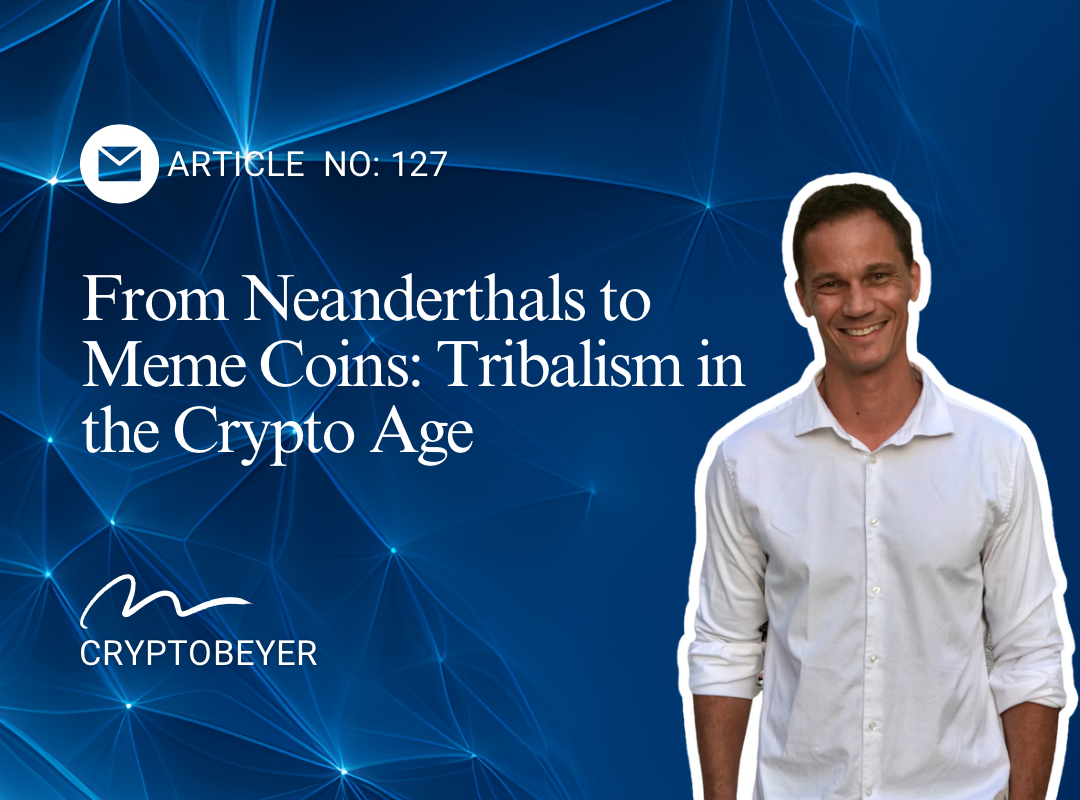
From Neanderthals to Meme Coins: Tribalism in the Crypto Age

Maximalism within certain cryptocurrency communities fosters tribalism and restricts the exploration of diverse perspectives, hindering innovation in the Web3 ecosystem. Our tendency to form close-knit groups online often leads to spaces where only certain voices are heard, excluding others. So called S… coins are compared to digital gold whereas meme coins are a joke. What’s really going on here and what do I think we can learn from this?

It's a Paleolithic phenomenon. Our ancient instincts and physiological responses, honed over millennia, are having a hard time to navigate the complexities of modern digital environments. This "mismatch" between our ancient instincts and modern realities creates a fertile ground for tribalism and polarization to flourish. Academically speaking, it's a matter of social cohesion and ideological diversity.

What do we need?

A discussion encompassing multiple differing thoughts and philosophies within the Web3 space is essential to fully comprehend humanity's complexities. After all, Bitcoin is not the remedy for all societal problems in the fourth industrial revolution. Neither is only having fun together in a meme coin rally. Just because I prefer the underlining philosophy of Cardano does not mean I cannot believe in the use case of XRP. What do you think?

Blockchain along with AI is god-like technology and we are not able to grasp its full potential and have not yet experienced the most transformative change in society. We must remember that our government structures, financial system, bureaucratic hierarchies, and political thoughts are not fully ready for these technologies. Change is a process! Humans hold on tight to old ways of living and engaging in society.

My message to Web3 builders is clear: Avoid the creation of echo chambers through tribalism, as progress necessitates dialogue between opposing viewpoints.

Why?  Change is obviously the process or act of altering from a previous state. To successfully adopt Web3 technology in society, an open-minded approach is imperative to accommodate diverse opinions, philosophies, and social and political needs.

“Web3 communities must actively promote empathy, understanding, and constructive engagement, and avoid a conflict-ridden rhetoric that hinder productive dialogue and collaboration.”

Apparently, Neanderthals were highly engaged in tribal warfare and failed to resist human expansion partly because of their limited ability to innovate, adapt, and cooperate in larger groups. Whereas modern society is built on cooperation and collaboration. Say no more.

Frankly being a crypto maximalist is against the very fundamental principle of the technology. Afterall, decentralization spread across the multitude of all that is the world. Decentralized governance mechanisms, enabled by blockchain technology, are avenues for participatory decision-making and collective problem-solving. Whereas centralized power structures and bureaucratic hierarchies hinder inclusivity and collaboration among diverse ideological factions. We are done with that right?

Categories
Business & Society

Singapore’s Leap into the Fourth Industrial Revolution: A Model for Countries

The technologies of the 4th Industrial Revolution have the power to offer brand new opportunities for innovation, effectiveness, and prosperity. This transformation of society calls for forward thinking and courage. Singapore is a leading example of a nation successfully navigating its way into the digital era. Here’s what Singapore is doing and what I see we can learn from it.

Singapore's technological journey traces back to the 1960s when it embarked on a path of industrialization, with the electronics manufacturing sector leading the way. Early on, the government understood the importance of having a digitally savvy population and has launched three highly successful programs since the 1980s to make it an intelligent island. This led to a significant increase in computer awareness.

In 2020, Singapore started the Advanced Manufacturing Training Academy which focuses on preparing the manufacturing workforce for the challenges and opportunities of 4th Industrial Revolution technologies. There’ s more. When I examine the national Manufacturing 2030 plan, it's evident that Singapore is fully committed to embracing these technologies.

In fact, Singapore created the globally recognized framework Smart Industry Readiness Index together with the World Economic Forum to help manufacturers assess their digital maturity. Smart.

What about Web3 in Singapore?

Singapore is embracing Web3 and is exploring how blockchain can be used for decentralized finance, tokenization, and digital asset innovation. Over 57% of adults in Singapore own cryptocurrency, but the preferred way of payment is still fiat currency. In Scandinavia, only approximately 7% of the population owns cryptocurrency, while in Germany, the figure stands at 6%, in the UK at 8%, and in the US at 15%.

Hear this! Singapore does not impose any capital gains tax on profits from buying and selling cryptocurrencies.

Lately, cryptocurrency usage has gone down in Singapore due to the prevailing problems of crypto exchange crashes and frauds, but all technological developments will have their ups and downs. To address concerns like money laundering and investor protection, Singapore is introducing fresh new rules while still supporting crypto innovation. By creating a supportive regulatory environment, Singapore has attracted major players in the crypto space and is now a major center for Web3 innovation.

What else does the government in Singapore do?

Singapore is recognized for its clear and steady regulatory approach towards blockchain and crypto. It offers funding and mentorship to startups developing innovative blockchain solutions. The Monetary Authority of Singapore has established a S$225 million Financial Sector Technology and Innovation scheme, with S$75 million specifically allocated for blockchain and distributed ledger technology projects. That’s what I call trust in innovation!

“It should be called the Fourth Industrial Evolution.” Because what we are experiencing with the merging of digital, physical, and biological technologies are inevitable developments. It’s an evolution of society that offers brand new opportunities for innovation, effectiveness, and prosperity. Trying to block the inevitable is senseless.

Following in the footsteps of Singapore will likely lead to economic advantages. With a strong manufacturing sector, the country can use 4th Industrial Revolution technologies to boost innovation and productivity, making it more competitive globally. Singapore's positive approach attracts foreign investment and skilled workers, and government-supported programs encourage new ideas and businesses in blockchain and robotics. Singapore’s clear emphasis on improving the skills of its workforce is sending a clear message. I say, Singapore is set to thrive in the digital era.

Categories
Business & Society

Trust in Tradition: Unpacking Scandinavian Skepticism Towards Cryptocurrency

Why is the Scandinavian cryptocurrency adoption rate only half of the global level? Here are the fresh facts: only 7% of the population in Sweden, Denmark, and 9% in Norway own cryptocurrencies. A resounding 80% of the population in these countries state that they will never buy crypto! Let’s explore what’s behind the prevailing skepticism of cryptocurrencies in Scandinavia.

On a global level, around 16% of the population owns cryptocurrency, and currently, about 15% of the US population has invested in crypto. Turkey, India, Vietnam, and Nigeria have the highest affinity for crypto. The Chainalysis 2023 Global Crypto Adoption Index shows that 8 out of the top 20 countries with the highest crypto adoption rates are developing countries in Central Asia, South Asia, and Oceania. So, what's the story behind this data?

“It’s a complex interplay between cultural values, economic stability, and a deeply ingrained trust in established financial institutions that explains the low crypto adoption rate.”

I would say that Swedes, Danes, and Norwegians have a cultural ethos steeped in pragmatism and skepticism. Generations have leaned on traditional financial systems and have found comfort in the stability that they offer. They respect conventional banking, and its structure is a part of the broader societal fabric of these nations. Being Swedish myself, I feel that a large part of the population in these countries finds a sense of security and predictability in the traditional financial system. In the face of cryptocurrency's notorious volatility, I certainly understand why there’s caution and skepticism.

Central to Scandinavian skepticism towards cryptocurrencies lies an unwavering trust in established financial institutions, even if they are far from perfect. But we must acknowledge that these nations have long benefited from robust banking systems and regulatory frameworks, fostering a sense of security and confidence among citizens. Let’s be clear: unlike the decentralized nature of cryptocurrencies, traditional banking offers oversight of financial markets, clearer assurances, and safeguards. This inherent trust in institutionalized finance serves as a barrier to widespread adoption of cryptocurrencies among Swedes, Danes, and Norwegians.

“Oops, my crypto was stolen!” Crypto exchange crashes, security breaches, and historic levels of fraud within the crypto sphere undoubtedly reinforce the preference for regulated and secure financial channels. It’s worth noting that all nascent technologies of this magnitude undergo teething problems before broader societal acceptance. Industrial revolutions are, after all, processes.

What's the solution?

I see the potential of the Markets in Crypto-Assets (MiCA) regulation in increasing institutional trust in crypto. That’s where we must start. The Markets in Crypto-Assets (MiCA) initiative seeks to establish a unified regulatory framework for crypto-assets, thereby improving transparency and enhancing consumer protection. In short, MiCA is about to go fully live late 2024 and it aims to instill greater trust among institutional investors.

I believe in a hybrid solution where traditional finance and crypto coexist, and for that, we need a cohesive framework.

I think that MiCA will trigger an increase in institutional investment in the EU crypto market by reducing regulatory ambiguities and creating a more regulated, standardized environment.

Here’s some insider buzz: Major European banks are poised to offer crypto-related services like custody, exchange, and stablecoin issuance within the next few years. I think this is when crypto investing gets the standardization that most Scandinavians need.

Categories
Business & Society

Cryptocurrency in Sweden: Insights from the Latest Study

Sweden confirms the notion that cryptocurrency mostly attracts young people but is still not crypto-friendly. A fresh 2024 survey conducted by K33 Research and EY shows that 550,000 Swedes, making up 7% of the adult population, have invested in cryptocurrencies. But let’s be clear, despite Stockholm being known for being a Fintech Hub in Scandinavia, crypto is still seen with skepticism. The traditional finance sector is still hesitant to dip their toes into the cryptocurrency lake. Here’s what the new study finds and what’s needed in Sweden.

The study confirms the notion that cryptocurrency mostly attracts young people as almost half of them are under 30 years old, and another 40% between the ages of 30 and 50. Additionally, the study highlights differences in crypto ownership between urban and rural areas, with Stockholm having a higher ownership rate at 10%. It's also noted that those with higher education and income levels are more likely to invest, which aligns with traditional investment patterns.

Another belief that can be confirmed is that men are three times as likely to invest in cryptocurrencies than women. However, there's a silver lining as more women reported purchasing their first coins in the last two years, indicating a potential narrowing of this gap. The survey also reveals that a majority of Swedish crypto owners bought their first coins during the COVID-19 crisis.

The study confirms the joke in the cryptocurrency community that people tend to buy cryptocurrency when the price is high. It’s unfortunate that most people entering the space suffer the consequences of falling prices at their first investment.

But let’s be clear: we are a product of our own actions and volatility is driven by greed.

Looking ahead, there's optimism among Swedish investors, with 20% expressing their intention to acquire cryptocurrencies within the next decade. If these projections materialize, Swedish crypto ownership could amount to 1.6 million by 2034. However, I think it’s a low prediction. I would like to give thanks to K33 Research and EY for conducting this much needed study.

Yes, in Sweden cash is dead and it has entered the realm of digital currencies with the e-krona pilot project and has explored the technical and legal aspects of a digital currency. But, in general, the government is paying little attention to the potential of blockchain technology and cryptocurrencies.

So, what’s needed in Sweden?

Sweden is experiencing a situation similar to many other nations. The entire web3 space needs to focus on improving user experience, effectively working to hinder illicit activity such as scams, and the traditional finance sector should meet with fintech firms and discuss how the technology best can be used for the common good. I hear that the tax authority (Skatteverket) has employed staff who are knowledgeable about cryptocurrency, and I hope traditional finance institutions follow suit. I have yet to hear a positive word about the potential of blockchain technology from the government, even though we are experiencing one of the biggest and fastest technological developments of mankind. I hear from multiple companies that operating a crypto company in Sweden is difficult, and traditional financial institutions and the central bank are clearly hindering the adoption of cryptocurrency. The study confirms the fact that millennials lead the way in cryptocurrency adoption, and I see a need for Sweden to become more open to the potential of blockchain technology for the common good. It’s not just as a circus ride in price volatility.

Categories
Business & Society

Ensuring Elderly Inclusion in the Youthful Web3 Revolution

Rarely do I encounter a substantial discussion about the needs of the elderly within the web3 community, even though the number of people aged 65 and older is growing faster than any other age group. Even if grandma isn't using crypto today, the developments in the web3 tech world need to consider all age-groups to create a fair and just digital development in society. Here’s why.

Firstly, web3 is far more than cryptocurrency. Web3 extends beyond cryptocurrency, embracing distributed applications and protocols that offer potential for transforming healthcare, notably enhancing data management, accessibility to medical services, and personalized healthcare experiences for the elderly.

Secondly, recent data sheds light on the demographic skew in cryptocurrency adoption: 94% of cryptocurrency buyers are from the younger age groups, predominantly Gen Z (18-24) and Millennials (25-40). Additionally, in terms of cryptocurrency awareness and understanding, men aged 25-34 tend to have a better grasp of the concepts compared to women and older respondents. The number of people aged 65 and older is growing faster than any other age group. Meanwhile globally, the number of people aged 80 and older is projected to almost triple between 2000 and 2050. Triple.

The crypto industry overwhelmingly favors younger age groups as they are more tech-savvy and comfortable with new financial technologies. They have grown up in the digital age and are more likely to embrace the jargon and the essence of non-traditional finance. Whereas seniors may feel intimidated by the fast-paced changes in technology. Many are unfamiliar with concepts like blockchain and decentralized finance. This lack of understanding can lead to feelings of exclusion and frustration.

The underlying premise is that the elderly prefer traditional investments like stocks and real estate. But development in the web3 space is far broader than investing, and the digital literacy of society will ultimately determine how successful the digital adoption will be. Elderly already face barriers to entry due to their age and digital literacy levels.

The other day, three elderly parked their car beside mine and asked me how they should pay for parking using their phone. “Forget about it… enjoy the spring sun instead,” I said, thinking that the knowledge gap seemed too wide. They laughed and smiled and went on with their day as it was free parking that day anyway.

By prioritizing the needs of seniors, we can pave the way for a more equitable and accessible digital landscape. Again, remember that web3 is more than cryptocurrency. For example, blockchain technology is quietly changing how we deliver medical care, a transformation from which all age groups stand to benefit.

So, what needs to be done?

We need to take proactive steps such as designing interfaces that are intuitive and easy to navigate for seniors, developing educational resources tailored to their needs, and establishing support networks to assist them in navigating the complexities of Web3 technologies.

 Technology is for people, not for technology itself.

It's essential to recognize the valuable contributions that seniors can bring to the Web3 ecosystem. Joda is old and wise. Their life experiences, wisdom, and unique perspectives can enrich our collective understanding and drive innovation forward. By empowering them to participate fully in the Web3 revolution, we unlock the full potential of digital technologies to create a brighter future for everyone.