

Categories
Business & Society

Rookie Mistake Alert and the Wisdom of Crypto Experts

The analogy that investing in Bitcoin is like riding a rollercoaster is appropriate. The value of Bitcoin goes through cycles of ups and downs, and parts of the ride will be scary. Really, there is no sure thing in investing, and crypto is a high-risk asset. I am not giving investment advice, only informing what the general talk is in the crypto space and learning from long-term investors. Therefore, I took a look at the biggest mistake that first-timers do when they invest in Bitcoin.

It seems that we need a strong stomach to handle the Bitcoin ride. The problem is that many new Bitcoin investors buy when the price is high and sell when the price is low.

It’s crucial to survive the first bear market!

The Bitcoin 4-year cycle is like a rollercoaster ride for the cryptocurrency. Every four years, something called the “halving” takes place. It’s when the number of new Bitcoins created gets cut in half. This scarcity of new coins tends to make the price of Bitcoin shoot up. So, you’ll see periods where the price skyrockets, and everyone gets excited. But after that, there’s usually a big drop or a bear market. It’s like a wild ride with ups and downs. By understanding this cycle, you can get an idea of what might happen next in the Bitcoin market and make smarter investment choices.

Experiencing a Bitcoin bear market for the first time can be daunting. This means that prices can drop significantly. Imagine you bought bitcoin when it was expensive, and then it dropped in value by over 75%. It can be scary! I have seen many people sell Bitcoin at a loss during times like this. In fact, Bitcoin data shows this.

Buy high:

Let’s focus on a group of investors called long-term holders (LTH). It is the people who hold bitcoin for the long term. But guess what? Even these experienced holders started somewhere. First, they can make mistakes and buy when Bitcoin is high. They learn from those experiences and become smarter investors over time. I would like you to be one of those smarter investors.

Sell cheap:

Now let’s talk about when people sell Bitcoin. When the price drops, investors may panic and sell bitcoin for even less than the price they bought it for. It’s like selling at a loss. This can happen if the price drops more than 50% of its value. Not a good situation.

Immediate Surrender:

Alert! Data suggest that we are in this period of time at the moment. We are likely roughly at the bottom of the rollercoaster and have started to go up. But beginners are shaken by the ride down. During this difficult time, when many investors are stressed and sell their bitcoin. Data shows that we have noticed a pattern. There are certain moments when new investors unfamiliar with Bitcoin sell the coin in large numbers. It’s like following the crowd and making the same mistakes.

Long-term learning curve:

It turns out that investing in Bitcoin takes time and experience. Remember: Novice investors often buy when Bitcoin is high and eventually sell when it is low. What to look for? There are signs you can look for to understand when these errors occur. For example, if you see a lot of people selling Bitcoin at a loss and the price is dropping further, it’s a sign that many novice investors are panicking.

If this is your first bear market, the statistics show that we need to be patient and strong and resist the urge to follow the masses.
Categories
Business & Society

Avoiding Emotional Investing: Lessons Learned from Past Mistakes

I know it can be tempting to make quick decisions, especially when you see a hot crypto or stock on the rise, but trust me, patience is key to making smart investments. In fact, MagnifyMoney survey found that 66% of investors have regretted an impulsive or emotionally charged investing decision. Emotions can be a significant factor in investing decisions. By recognizing and managing your emotions, you can avoid making impulsive decisions based on fear or greed. I think you can relate!?????

This approach is a recipe against the dreaded fear of missing out (fomo).

When it comes to investing, you shouldn’t rush it. Doing your research is crucial before making any decisions. Take the time to study the market and the company you’re interested in. Don’t just go with your gut feeling or a hot tip from a friend. I learned this the hard way when I made a swift move and invested in Rain Maker Games at the top of the 2021 bullmarket. I did no research and was lured by the dramatic price upswing. Let me tell you, a crypto bullmarket is sexy and can certainly entice you to invest. Turns out, Rain Maker Games dropped by 99 percent. But I tell myself that I have not lost anything unless I sell the token. I have also bought crypto after drinking wine… Apparently, I am not special even if my mom says so…. 32% of investors have traded while drunk according to a study by MagnifyMoney.

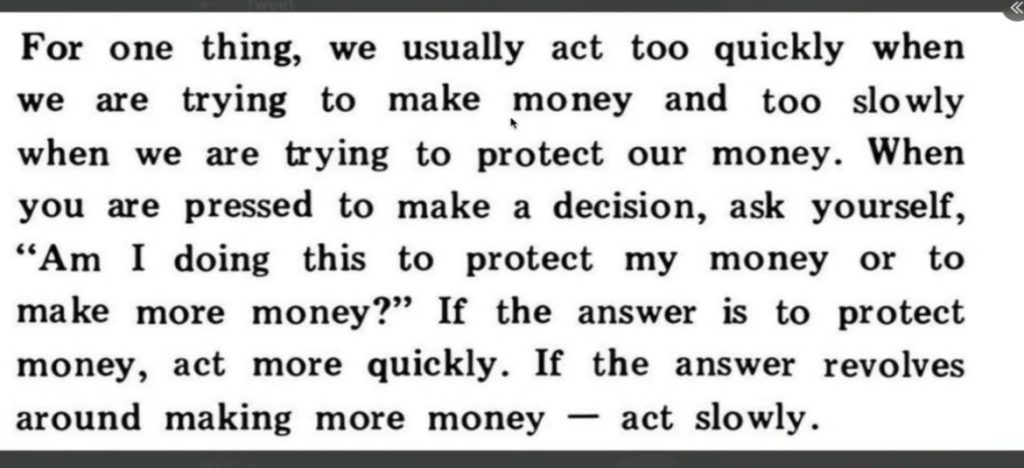
I believe that we need to be slow when investing to reduce the impact of emotions. Avoid investing on a green day. We all get caught up in the hype of a hot asset or panic during a market downturn.

But by taking a more measured approach, we can avoid getting swayed by short-term fluctuations.

It’s like they say, “Invest in the company, not the stock price.”

Now, when it comes to selling, that’s a different story. We can benefit from acting fast! If an investment isn’t performing well, it’s best to cut your losses and move on. Don’t hold onto a sinking ship, hoping it will eventually turn around.

On the other hand, if an investment is doing really well, don’t get greedy. It’s tempting to hold onto it and hope for even more gains, but that’s a risky move. Markets can be unpredictable, and what goes up can quickly come down. So, when I see a significant profit on an investment, I try to sell some of it to lock in those gains. It’s a safer strategy, and it ensures that I don’t lose everything if the market takes a turn for the worse. Profit is profit, regardless of its size.

I have heard multiple times in the crypto space that investing is all about patience, discipline, and a solid strategy. But sticking to a strategy can be difficult. Sure one can buy and hold an asset for years and be a truly successful investor. Not selling is also an action.

However, I remind myself to take my time when investing, do the research, and avoid getting caught up in emotions in an ongoing hype. We need to give ourselves at least a day or two and step out of the hype bubble before deciding what to do. In a 2020 survey conducted by The Harris Poll, 72 percent of American investors said that current events and news influenced their decisions. Obviously, staying up to date is good but always reacting is not.

But, when it’s time to sell, act fast and stick to the plan that you decided on. With this approach, you’ll be on your way to making smart investments.

The problem with this approach is that it’s obvious. In a way it’s too simple. Therefore I fear that I will not be able to take it seriously.

But I believe its valuable to remind ourselves and friends of our tendencies to falter when investing turns emotional.

Do you have an investment strategy or do you wing it?

Please share your knowledge and lessons.

Categories
Business & Society

Maximizing Returns in the Crypto World: A Guide to Navigating Volatility, Risk, and Opportunity

Old-timers in the crypto space will tell you that they love the volatility. Brutal dips, trips to the moon, and crypto winters offer opportunities, but they are not for the faint of heart. The volatility in the price of cryptocurrencies makes it a great trading asset, but be warned – the word in the crypto community is that 90% of traders are unsuccessful.

I avoid trading and instead believe in the long-term potential of cryptocurrencies. Over time, I’ve learned vital lessons about investing in crypto. The volatility is both a blessing and a curse, providing opportunities for traders but also being nerve-wracking for those not comfortable with risk. A long-term perspective on owning crypto requires the ability to tolerate dramatic price swings.

Many in the crypto community believe that the price of Bitcoin follows a four-year cycle, as history has shown repeatedly. It’s debatable whether we’re in a bear market right now. If Bitcoin has hit bottom, then we are in the early stages of a bull market. However, some might refer to this phase as an accumulation phase, as prices are expected to rise slowly for almost a year. The next major uptrend is predicted for mid-2024, but history may not repeat itself. To increase your market stamina, I suggest taking a long-term view and not tracking market prices daily. Holding crypto costs nothing, and some coins even offer interest through staking rewards. 

Staying informed about news and events in the crypto world is also valuable, keeping an eye out for regulatory changes, investor sentiment, and technological developments that could impact your investment.

However, it’s important to remember that crypto is risky. But it has taught me to consider and value my retirement. Some say the crypto boom is a once-in-a-lifetime chance to change our financial future, and that’s the key word – future. Crypto is a lesson in valuing your future self, hopefully.

Categories
Business & Society

Why Big Money Get Crypto Mostly Wrong

Things are not as they seem in the investment world. We have a false image of the greatness of venture capital. What is behind all the failing crypto projects and why can’t even venture capital get it right?

In essence venture capital (VC) is a company or investment firm that provide financial support to small, emerging companies with the potential for significant growth. Usually, a venture capital firm get a stake in the company, and they provide additional resources like management expertise and industry connections to help the company succeed. At first glance it sounds like it’s a given success for a small company when they get support from a venture capital firm. It’s a Dragons Den scenario in many ways. However, the success rate of venture capital investments is notoriously low. In fact, 63% of startup failures occur in the tech industry, and 75% of venture capital-backed startups fail. Being successful in business is difficult even with capital and know-how. Blockchain companies face an even tougher road to success.

Since Bitcoin was released the staggering amount of 80,000 blockchain projects have launched. However according to the China Academy of Information and Communications Technology only 8% of them are still active and the average lifespan is only 1.22 years. Gartner estimates that only 5% of blockchain projects make it to production, and 90% of those will need to be replaced within two years to remain competitive. The statistics give us a sobering view of the crypto industry. We can easily conclude that it’s smart to invest in the biggest crypto projects that have been around for multiple years.

But what are the reasons why blockchain companies struggle?

Firstly, the industry is in an early-stage and lack of adoption is a problem. Many crypto companies are struggling to guide themselves in an unclear regulatory setting. In the US, crypto companies can suddenly be dragged into court by authorities for unclear reasons because the regulatory landscape is still being created. Intense competition between crypto companies is another reason for projects failing. The crypto space is difficult to predict as its still in many ways hype driven and not only the most sound and useful coins win the market race. Funding issues and technological difficulties are also a significant contributor to the fail rate of crypto companies. Few companies survive the freezing cold crypto winter that we are in the middle of. They are forced to cut spending when markets are down, and venture capital is in many ways the only way to succeed. Another likely reason for the huge fail rate in the crypto space is that its surprisingly easy to launch your own crypto token and many unserious people are eager to get their hands on some crypto cash. There are thousands of poop coins that really stink. However, building a solid crypto project that stand the test of time requires a high level of skill and knowledge and is a time-consuming process. No wonder that most crypto projects fail.

It may seem crazy, but venture capital firms continue to pour billions into the space and clear regulatory guidelines are being created. Most money will clearly be lost but some companies will win big time. Clearly even big money gets it wrong when it comes to crypto investments.

No wonder it’s a high-risk and high-reward game.

Categories
Business & Society

Crypto crisis — Should I buy or sell?

We have been bombarded by grave crypto news for months now. It’s a bad crisis. Seriously bad. What to do with our hard-earned cash?

Media have jumped on the opportunity to make dramatic click-bait headlines portraying an apocalyptic situation for the crypto industry. The contagious shitstorm started with the collapse of TerraUSD, Three Arrows Capital and Celcius Network and continued with fraudulent practices by crypto exchange FTX and Alameda Research.

It’s like a thrilling HBO series.

It’s an ongoin crisis. The contagion effect of the collapse of FTX and Alameda Research caused Voyager and Blockfi to go bankrupt, and the problems will continue lower down the crypto food chain. The industry is wondering why the crypto villain, SBF, is not arrested and is still free to party in his penthouse in the Bahamas. Rumor has it that prominent politicians and high-profile people in regulating organizations have been paid off.

What’s worse? Well, we have the imminent global depression and the war in Ukraine. Limitless printing of fiat currency and inflation is making us considerably financially weaker. Global macro-economic factors tell a worrying tale, and the crypto market is no different.

We cannot possibly buy crypto now right!?

The word in the crypto space is that people who invest long-term should consider buying in a shitstorm. Those looking to make a quick buck should walk away. If you bought your first crypto in 2021 it’s too late to leave the party without a loss. You might as well have a sleep-over. Make some popcorn, take a warm blanket and cuddle-up on the sofa, and enjoy the thriller. It’s only pretend money anyway right!?

But seriously. We need to look at least 16 months into the future before we can expect a clear uptrend in the crypto market. The reason for the wait is not because of the current situation. Crypto enthusiasts are waiting for the next Bitcoin halving which is on the 29th of March 2024. Until then there will likely not be much price action. The Bitcoin halving-cycle has been right so far in predicting when the price of Bitcoin will go up and down. That trend is still your friend.

If we look through the shitstorm we will see a much more developed crypto landscape. Research shows that crypto currency is a legitimate investment. In fact, investment research shows that 2 percent of the total investment portfolio should be crypto currency such as Bitcoin.

Moreover, considering that most banks invested in blockchain related companies in 2021, newcomers are in a good spot right now to enter the market. After the crypto market downturn in 2021, KB Financial Group, United Overseas Bank, Citigroup, Goldman Sachs, and Commonwealth Bank of Australia have continued their investments in the crypto space. The word on the streets is that it’s smart to follow in the footsteps of big players. We can be sure that banks are in it for the money.

Those involved in the crypto space are slowly starting to buy to increase their positions before next bull run around March 2024. But remember, this is edutainment only and I am not a financial advisor. It’s wise not to invest. But it’s also wise to invest after doing your own research.

One thing is likely. The sky clears after the storm.

Categories
Business & Society

Can we trust our instinct in investing?

Crypto trading is not entirely based on chance. Sufficient knowledge of crypto and macro economics and a clear strategy is important. But knowing what factors are beyond our control may be vital.

Disclaimer: This is education only, and not financial advice. Please, do your own research and consider what is best for your financial situation. Be careful friends.

There are two basic ‘do’s and don’ts’ in investing. Buying a crypto coin after a 40% daily surge in price is likely to be a ill-advised decision. On the other hand, buying crypto when the price has recently dropped seems to be a better decision. That is straight forward enough. But investing can easily get far more complex in the balance between what we think we know and control and what we don’t know and can’t control. There’s a risk that we over-estimate our chance of winning just because we apply specific types of knowledge or skills.

We may think that we see patterns and correlations between things. In fact, the academic term ‘patterning instinct’ describe our instinct to see patterns to understand something. This ability is fantastic for making sound decisions based on our understanding and knowledge. However, there is also a risk that we think we see a pattern or a link between things that do not exist. For example, people do not grow longer because they play basketball. In crypto some influencers may claim they see correlation between the moon and the price of Bitcoin. Some put a great deal of emphasis on technical analysis without considering important macro-economic factors that impact the price of a coin. The tricky part is that there may be some factors that have a reciprocal relationship, but they are only very loosely connected. It’s a similar situation for conspiracy theories that may have some truth to them, but the overall message is incorrect.

Hindsight bias (the outcome is seen as being hypothesized all along) is also a common problem amongst influencers in crypto. We would very much like to be right… regardless of what happened. Self-serving attributions also seem to frequent the crypto space as it’s a nice feeling to attribute success to ourselves. In a bull run with favorable market conditions it can seem that any advice or correlation theory leads to profit, as the trend reinforces our actions.

In trading we also try to identify predictable momentum shifts before we buy or sell crypto assets. The bitcoin halving event is such a predictable factor. But the trend is only a friend until it’s broken.

Can we trust our instinct in trying to see patterns between things? Yes and no. At some point our instinct to try to understand and to control the outcome can lead to financially bad decisions.

Watch out! Research has shown that people who experience gambling problems tend to more strongly believe that knowledge and skills, and certain rituals can increase the likelihood of winning. It seems healthy to know how far our arms of control can reach. Our sense of control can be an illusion.

To reduce the risk of overestimated perceptions of control, we need to be aware that crypto value is highly correlated with Bitcoin. It is unlikely that any coin will rise unless Bitcoin is rising as well.

A friendly reminder. Strong fundamentals are not equal to price. A crypto project with a strong fundamental use case may not increase in price until Bitcoin is stable and there is confidence in the crypto market. Because crypto assets follow bitcoin it is difficult to limiting the risk of losses through diversifying the portfolio. To make matters worse, a bitcoin fall will usually mean a wipe-out for altcoins.

What to do?

To reduce the risk of overestimated our perception of control we can follow core rules:

1. Take profits when the coin increase in price.

2. Maintain some liquidity by converting some crypto assets into stable coins.

3. Focus on crypto projects that are most likely to be here for many years to come.

4. Be skeptical of influencers that claim they have found the ‘secret’ in trading.

Sure, the crypto market is still volatile since the market value is still low. Therefore, whales can influence the price of crypto currencies with their big pockets. But no one has complete control over Bitcoin. Furthermore, living with the sometimes-uncomfortable feeling of lack of control is part of life.