
Categories
Business & Society

US Stifling Innovation? China Seizing Crypto Opportunities

The USA is the biggest crypto market with 46 million crypto holders, but unclear rules and regulations are causing crypto investors and companies to leave the country. Meanwhile, China is opening its doors. Crypto! Welcome to China!

 Frankly, the US needs to get its sh.. together before it has created a truly unfriendly environment for innovation. The traditional finance sector and the government are both successful and unsuccessful in trying to crush crypto. Crypto regulation is still being affected by guiding principles that were created in the 1940s… and the first major blockchain Bitcoin was invented in 2009. How stupid is that? No wonder the regulatory crypto environment is a complete mess in the US. Meanwhile, arch-nemesis China, who loves money, has seen an opportunity.

 But China has not always had a passionate romance with crypto. In late 2001, China’s central bank declared all cryptocurrency-related transactions as illegal, which was the strongest move against the digital asset industry thus far. But China has banned cryptocurrencies at least 7 times…

 After considerable political struggles with mainland China, Hong Kong needed to build a business-friendly environment and has opened its doors to crypto trading. In fact, Hong Kong’s treasury chief says that they need crypto regulation, but he insists that crypto is here to stay. He is basically saying “game on” for crypto, and Hong Kong is creating a global hub for crypto.

 It is not yet clear which cryptocurrencies will be available for retail customers on exchanges, but rumors in the crypto community say Bitcoin, Ethereum, Litecoin, Solana, Cardano, and Polygon are likely cryptocurrencies. Is Hong-Kong based crypto exchanges the first step to mainland China?

 Yes, this is bullish news for the crypto industry, but it will take some time for Hong Kong-based exchanges to get approval to open up. Therefore, a “boom-to-the-moon” scenario is not likely in the short term. But Hong Kong adds to a future bull run!

 It’s strange, Chinese policymakers have embraced blockchain as a game-changer, with President Xi Jinping declaring it a cornerstone of future innovation and industrial transformation. Whereas the US president has called for an “unprecedented focus of coordinated action” from federal agencies in mitigating illicit finance and national security risks posed by cryptocurrencies. Regulate through enforcement is the hallmark of US regulatory bodies. This is stupid! Did you know, according to Chainalysis, illicit addresses made up only 0.24 percent of the total cryptocurrency transaction volume in 2022. Say no more…

 Yes, the US is ranked nr:5 in the 2022 Global Crypto Adoption Index and has come further than China which is ranked as nr:10. Western countries would like to think that the US has a brighter crypto future despite the current unclear regulations. I believe so too. I fear the future of a digital China which has complete control of its citizems financial life through a programable coin. The digital yuan is here and should be feared. 

 But US regulatory bodies need to focus more on the possibilities of blockchain technology. As well as to create a business friendly landscape. Not mostly on the 0.24 percent of the crypto volume which is bad. Let’s be smart, instead.
Categories
Business & Society

Understanding the Inherent Value of Bitcoin: A Beginner’s Guide to Crypto

Bitcoin has sparked much debate about its intrinsic value. I seem to have these discussions frequently and I would like to address the most frequent beliefs about crypto and Bitcoin.

Some argue that Bitcoin has no real value, while others believe it has great value. What do I say in this discussion. Does it really hold value?

Bitcoin is valuable because it is a decentralized currency. This means that it is not controlled by any government or financial institution and its value is determined solely by supply and demand. In a world where central banks can manipulate fiat currencies, Bitcoin’s decentralized nature makes it a worthy alternative.

Bitcoin is valuable because of its scarcity. There are only 21 million Bitcoins, and this rarity is similar to precious metals such as gold. The more people accept bitcoin, the more its scarcity becomes apparent and its value increases.

Bitcoin is valuable because of its utility. It can be used to purchase goods and services, and can also be used as a store of value. This means that people can hold onto Bitcoin and watch its value rise over time, just like investing in stocks or other assets.

Bitcoin is valuable because of its security. The Bitcoin network is based on blockchain technology and is highly secure and difficult to hack. This makes Bitcoin a safe and reliable way to transfer value, adding to its value proposition. After all, Bitcoin is valuable because it is a global currency. Unlike fiat currencies, which are tied to a specific country, Bitcoin can be used anywhere in the world. This is an attractive option for frequent travelers and those doing business internationally.

In fact Bitcoin hold value for similar reasons as fiat currency. Belief!

Like fiat currency, Bitcoin’s value is based on belief and trust in the system. Fiat currency is backed by government commitments to recognize it as legal tender and to regulate its supply and demand. Basically, it’s about belief in politicians and the governmental and financial system. Similarly, Bitcoin’s value is based on belief, but on the belief of a decentralized system that it will continue to be widely adopted and will continue to function well.

But crypto is super volatile! Right?

Like fiat currencies, Bitcoin’s value is also influenced by market forces such as supply and demand, geopolitical events, and investor sentiment. Due to these factors, both fiat currency and Bitcoin experience fluctuations in value. But yes, crypto may be seen as a higher risk than stocks depending on what you invest in. Yet, Bitcoin is the highest performing asset of all 2023 according to JP Morgan. Infact, the highest performing asset the last 12 years.

So there we have clear reasons why Bitcoin has inherent value. Its decentralization, scarcity, availability, security, and global nature all contribute to its value proposition.

We all have different tolarance of risk and volatility is in the eyes of the beholder.

Categories
Business & Society

Avoiding Emotional Investing: Lessons Learned from Past Mistakes

I know it can be tempting to make quick decisions, especially when you see a hot crypto or stock on the rise, but trust me, patience is key to making smart investments. In fact, MagnifyMoney survey found that 66% of investors have regretted an impulsive or emotionally charged investing decision. Emotions can be a significant factor in investing decisions. By recognizing and managing your emotions, you can avoid making impulsive decisions based on fear or greed. I think you can relate!?????

This approach is a recipe against the dreaded fear of missing out (fomo).

When it comes to investing, you shouldn’t rush it. Doing your research is crucial before making any decisions. Take the time to study the market and the company you’re interested in. Don’t just go with your gut feeling or a hot tip from a friend. I learned this the hard way when I made a swift move and invested in Rain Maker Games at the top of the 2021 bullmarket. I did no research and was lured by the dramatic price upswing. Let me tell you, a crypto bullmarket is sexy and can certainly entice you to invest. Turns out, Rain Maker Games dropped by 99 percent. But I tell myself that I have not lost anything unless I sell the token. I have also bought crypto after drinking wine… Apparently, I am not special even if my mom says so…. 32% of investors have traded while drunk according to a study by MagnifyMoney.

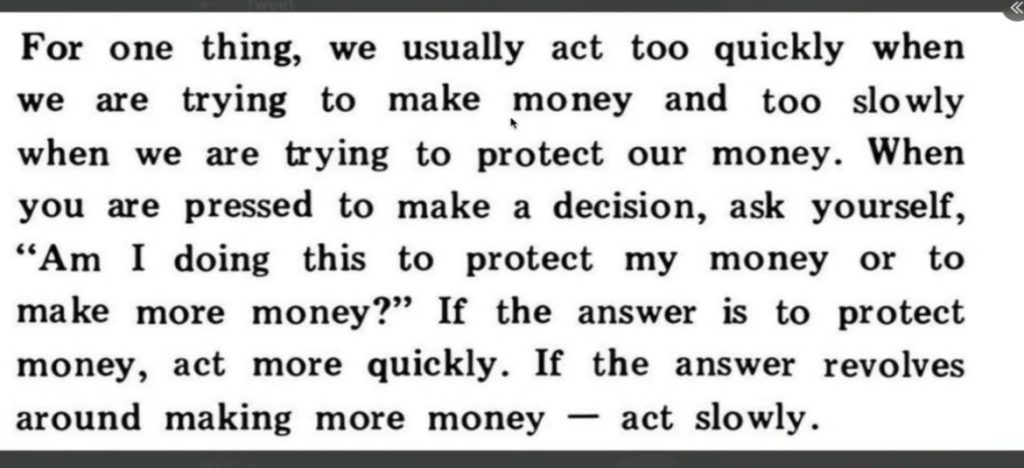
I believe that we need to be slow when investing to reduce the impact of emotions. Avoid investing on a green day. We all get caught up in the hype of a hot asset or panic during a market downturn.

But by taking a more measured approach, we can avoid getting swayed by short-term fluctuations.

It’s like they say, “Invest in the company, not the stock price.”

Now, when it comes to selling, that’s a different story. We can benefit from acting fast! If an investment isn’t performing well, it’s best to cut your losses and move on. Don’t hold onto a sinking ship, hoping it will eventually turn around.

On the other hand, if an investment is doing really well, don’t get greedy. It’s tempting to hold onto it and hope for even more gains, but that’s a risky move. Markets can be unpredictable, and what goes up can quickly come down. So, when I see a significant profit on an investment, I try to sell some of it to lock in those gains. It’s a safer strategy, and it ensures that I don’t lose everything if the market takes a turn for the worse. Profit is profit, regardless of its size.

I have heard multiple times in the crypto space that investing is all about patience, discipline, and a solid strategy. But sticking to a strategy can be difficult. Sure one can buy and hold an asset for years and be a truly successful investor. Not selling is also an action.

However, I remind myself to take my time when investing, do the research, and avoid getting caught up in emotions in an ongoing hype. We need to give ourselves at least a day or two and step out of the hype bubble before deciding what to do. In a 2020 survey conducted by The Harris Poll, 72 percent of American investors said that current events and news influenced their decisions. Obviously, staying up to date is good but always reacting is not.

But, when it’s time to sell, act fast and stick to the plan that you decided on. With this approach, you’ll be on your way to making smart investments.

The problem with this approach is that it’s obvious. In a way it’s too simple. Therefore I fear that I will not be able to take it seriously.

But I believe its valuable to remind ourselves and friends of our tendencies to falter when investing turns emotional.

Do you have an investment strategy or do you wing it?

Please share your knowledge and lessons.

Categories
Business & Society

Crypto and the Fourth Industrial Revolution: What to Expect

I’ve been watching the growth and development of cryptocurrencies, and it’s truly been awe-inspiring to witness its rapid evolution. However, the crypto world, like any technological shift, is far from perfect and has to numerous challenges to overcome.

For example, the Bitcoin network is often struggling with scalability issues, resulting in slow confirmation times and high fees during periods of great network demand. Additionally, the crypto space is vulnerable to bad actors who take advantage of weaknesses for their own financial gain. In 2022, North Korean-linked hackers made off with $3.8 billion in crypto, while two nerds created a Ponzi-scheme and defrauded investors and laughed all the way to the bank.

For crypto currencies to reach their full potential and be widely adopted, they need a robust infrastructure to support them. This includes secure and reliable exchanges, user-friendly and safe wallets, and efficient payment systems. Clear regulations are clearly necessary to protect customers and prevent illegal activities.

I understand that the crypto space can be confusing and intimidating for many people, but it’s crucial that we educate ourselves about the benefits and potential of crypto currencies. By being proactive and taking measures to prevent problems, we can be more efficient and less prone to making costly mistakes.

The crypto world is still in its early stages of development, and there are many challenges and risks that need to be addressed. However, with proper security measures and regulations in place, the potential for crypto currencies to transform the financial landscape is enormous. Investors should be proactive and well-informed when making investment decisions in this space and prioritize the protection of their assets.

There are also societal consequences of disrupting technologies that are important to consider.

For example, the fourth industrial revolution, with its focus on automation, artificial intelligence, and blockchain technology, will likely result in changes to the job market. While it’s impossible to predict the extent of these changes, it’s crucial for workers to be proactive and prepare for a rapidly evolving job market.

In conclusion, the crypto revolution presents both challenges and opportunities. However, I think we need the shitstorm of difficulties before we can expect to have a solid product. Remember, crypto currencies are not a final product and hundreds and thousands of developers are working on each blockchain. The blockchain business is a process affected by the vision of the coin, laws, regulation, crime, customer needs and dreams of profit. I consider it a space to learn from.

Categories
Business & Society

Why Big Money Get Crypto Mostly Wrong

Things are not as they seem in the investment world. We have a false image of the greatness of venture capital. What is behind all the failing crypto projects and why can’t even venture capital get it right?

In essence venture capital (VC) is a company or investment firm that provide financial support to small, emerging companies with the potential for significant growth. Usually, a venture capital firm get a stake in the company, and they provide additional resources like management expertise and industry connections to help the company succeed. At first glance it sounds like it’s a given success for a small company when they get support from a venture capital firm. It’s a Dragons Den scenario in many ways. However, the success rate of venture capital investments is notoriously low. In fact, 63% of startup failures occur in the tech industry, and 75% of venture capital-backed startups fail. Being successful in business is difficult even with capital and know-how. Blockchain companies face an even tougher road to success.

Since Bitcoin was released the staggering amount of 80,000 blockchain projects have launched. However according to the China Academy of Information and Communications Technology only 8% of them are still active and the average lifespan is only 1.22 years. Gartner estimates that only 5% of blockchain projects make it to production, and 90% of those will need to be replaced within two years to remain competitive. The statistics give us a sobering view of the crypto industry. We can easily conclude that it’s smart to invest in the biggest crypto projects that have been around for multiple years.

But what are the reasons why blockchain companies struggle?

Firstly, the industry is in an early-stage and lack of adoption is a problem. Many crypto companies are struggling to guide themselves in an unclear regulatory setting. In the US, crypto companies can suddenly be dragged into court by authorities for unclear reasons because the regulatory landscape is still being created. Intense competition between crypto companies is another reason for projects failing. The crypto space is difficult to predict as its still in many ways hype driven and not only the most sound and useful coins win the market race. Funding issues and technological difficulties are also a significant contributor to the fail rate of crypto companies. Few companies survive the freezing cold crypto winter that we are in the middle of. They are forced to cut spending when markets are down, and venture capital is in many ways the only way to succeed. Another likely reason for the huge fail rate in the crypto space is that its surprisingly easy to launch your own crypto token and many unserious people are eager to get their hands on some crypto cash. There are thousands of poop coins that really stink. However, building a solid crypto project that stand the test of time requires a high level of skill and knowledge and is a time-consuming process. No wonder that most crypto projects fail.

It may seem crazy, but venture capital firms continue to pour billions into the space and clear regulatory guidelines are being created. Most money will clearly be lost but some companies will win big time. Clearly even big money gets it wrong when it comes to crypto investments.

No wonder it’s a high-risk and high-reward game.

Categories
Business & Society

Crypto’s Crazy Way to Adoption

Things have always been crazy in crypto, but not this loud. Now days even my 80-year-old neighbor have heard about recent crypto crashes. How did we get here and what does the road to adoption look like?

KEY TAKEAWAYS

· Bitcoin grew up as an outcast and a joke. Until its technology disrupted the financial world. The ride to full adoption is turbulent, but crypto is here to stay.

Bitcoin was born after the global financial crisis in 2009, but without a buzz. In fact, all we heard from Bitcoin were crickets. The jaw-dropping blockchain technology of Bitcoin was ignored. The first time we heard from Bitcoin was when a guy bought 2 pizzas for 10,000 Bitcoin on May 22, 2010. It took three years before Bitcoin started to have some traction across the world.

In 2013, The city of Vancouver opened the first Bitcoin ATM and Germany considered Bitcoin as a financial instrument, but not e-money. The US Drug Enforcement Administration were busy seizing Bitcoin for the first time in 2013. Plenty of shady people used Bitcoin for transactions without understanding that every transaction is transparent and law enforcement agencies started having an eye on the blockchain. Various Bitcoin payment processors set-up business and crypto exchanges emerged, and things were picking up. Then in 2014 the world’s largest exchange Mt. Gox was hacked and filed for bankruptcy. Since Mt. Gox handled about 80 percent of the world’s Bitcoin transactions most people thought the crypto industry was dead. Bitcoin became a joke and people started to refer to Bitcoin as magic internet money.

Bitcoin is ‘probably rat poison squared’

The fight against crypto went viral as headlines in media read: The Great Bitcoin Scam, You’d be Crazy to Actually Spend Bitcoin, Warren Buffett said that Bitcoin is ‘probably rat poison squared’. Since blockchain technology eliminates the middleman in economic transactions traditional banks started spreading fear, uncertainty, and doubt about Bitcoin. Meanwhile they quietly started stacking up on Bitcoin themselves. Now days, major banks use blockchain technology to increase the speed and efficiency of transactions.

Bitcoin has had dramatic mood swings up and down in a four-year cycle. At the top in 2021 one Bitcoin cost almost 70,000 USD before falling to 16,500 in 2022. However, if we look at the Bitcoin price since its birth no traditional asset beats its increase. The price of Bitcoin will likely continue to be volatile until the traditional finance sector fully embraces it.

In 2022 the craziness continued. TerraUSD , Celsius and Three Arrows Capital crashed. Then the world’s second biggest exchange FTX kick the crypto space in the nuts and laughed when they bought real estate with customer funds. Then they filed for bankruptcy. The contagion of the FTX crash is still a major concern for other exchanges and crypto lenders who owned the FTX token FTT.

Currently the war on crypto has turned its focus on the greatest problem that really has nothing to do with the groundbreaking technology of blockchain. Lack of regulation fosters criminal activity and the biggest investors from the traditional financial sector are still on the sideline waiting for regulatory clarity before investing fully. Nation states have not been able to keep up with the fast pace of digital technology. Crypto will not be adopted by the public for years to come.

So, there we have it folks. The road to public adoption of blockchain technology is rocky to say the least. Disruptive developments in society seem to follow a path.

Gandhi said it best “First they ignore you, then they laugh at you, then they fight you, then you win.”

In the end, the good of crypto will win if we are willing to have a grown-up debate and a healthy look at the vast opportunities of crypto currencies and blockchain technology. The tech is clearly steadfast and a part of our future.

Categories
Business & Society

Crypto crisis — Should I buy or sell?

We have been bombarded by grave crypto news for months now. It’s a bad crisis. Seriously bad. What to do with our hard-earned cash?

Media have jumped on the opportunity to make dramatic click-bait headlines portraying an apocalyptic situation for the crypto industry. The contagious shitstorm started with the collapse of TerraUSD, Three Arrows Capital and Celcius Network and continued with fraudulent practices by crypto exchange FTX and Alameda Research.

It’s like a thrilling HBO series.

It’s an ongoin crisis. The contagion effect of the collapse of FTX and Alameda Research caused Voyager and Blockfi to go bankrupt, and the problems will continue lower down the crypto food chain. The industry is wondering why the crypto villain, SBF, is not arrested and is still free to party in his penthouse in the Bahamas. Rumor has it that prominent politicians and high-profile people in regulating organizations have been paid off.

What’s worse? Well, we have the imminent global depression and the war in Ukraine. Limitless printing of fiat currency and inflation is making us considerably financially weaker. Global macro-economic factors tell a worrying tale, and the crypto market is no different.

We cannot possibly buy crypto now right!?

The word in the crypto space is that people who invest long-term should consider buying in a shitstorm. Those looking to make a quick buck should walk away. If you bought your first crypto in 2021 it’s too late to leave the party without a loss. You might as well have a sleep-over. Make some popcorn, take a warm blanket and cuddle-up on the sofa, and enjoy the thriller. It’s only pretend money anyway right!?

But seriously. We need to look at least 16 months into the future before we can expect a clear uptrend in the crypto market. The reason for the wait is not because of the current situation. Crypto enthusiasts are waiting for the next Bitcoin halving which is on the 29th of March 2024. Until then there will likely not be much price action. The Bitcoin halving-cycle has been right so far in predicting when the price of Bitcoin will go up and down. That trend is still your friend.

If we look through the shitstorm we will see a much more developed crypto landscape. Research shows that crypto currency is a legitimate investment. In fact, investment research shows that 2 percent of the total investment portfolio should be crypto currency such as Bitcoin.

Moreover, considering that most banks invested in blockchain related companies in 2021, newcomers are in a good spot right now to enter the market. After the crypto market downturn in 2021, KB Financial Group, United Overseas Bank, Citigroup, Goldman Sachs, and Commonwealth Bank of Australia have continued their investments in the crypto space. The word on the streets is that it’s smart to follow in the footsteps of big players. We can be sure that banks are in it for the money.

Those involved in the crypto space are slowly starting to buy to increase their positions before next bull run around March 2024. But remember, this is edutainment only and I am not a financial advisor. It’s wise not to invest. But it’s also wise to invest after doing your own research.

One thing is likely. The sky clears after the storm.

Categories
Business & Society

Fiction is reality in retail

Vegan leather jackets, smart mirrors, drone deliveries and digital assistants will take shopping to new dimensions. The future is faster than we think in retail. What will the future look like in retail and how will it impact our lives?

“Show me how I look in a pair of white sneakers from Nike!”

“Change to my black vegan leather jacket!”

“Show me a cool cap that matches the jacket? Great, buy that one!”

These will be normal commands that we tell our smart mirror to do for us. The smart mirror will be connected to the internet and store a digital version of our clothes and be voice-activated and assisted by artificial intelligence. Voice activated commerce mean that you will ask, and you shall receive. You will be able to ask the smart mirror to show a high-resolution image of yourself in various clothing and tell your digital assistant to buy it for you. Since you will be able to do a full-body scan with your phone you can be sure that the digital assistant will order the correct size of clothing. Yes, the order will be delivered to your door by a drone.

The future of shopping is presenting a thrilling picture.

The internet of things does not only mean that things are connected to the internet but also assisted by AI via our phones and glasses. We will be able to live in two worlds at the same time. Augmented reality is a merge between reality and different digital worlds that we can chose to participate in if we like. It will be like walking in our hometown but being able to shop from all corners of the world when we participate in the augmented reality through our glasses.

There will still be shops, but they will be fully delocalized if they choose a business model that embrace augmented reality. Local shops will be able to sell a vast catalogue of online products and purchases will be automatically paid for via our digital ID when we leave the shop. You will be able to buy a vegan leather jacket as leather can be grown using stem cells. Your digital wardrobe will be updated with a digital copy of each purchase of clothing.

When we think about it, the future of online shopping is already here. The difference will be in the use of augmented reality which will offer a new dimension for digital shopping. A man will only see men’s clothing when he enters a physical shop that use an augmented reality. Whereas women will only see handbags…

The future of shopping is highly personalized using AI and blockchain technology. Everyone will have a digital ID that we can use for personal and professional services and payments in crypto currencies or central bank digital currencies. The digital ID will store personal data such as health records, passport details, banking details and ownership of land. Our digital assistance and AI will store details such as our favorite clothing brand or color or remind us about buying birthday gifts.

When we merge highly personal data with AI it is difficult to see a clear picture of all problems and possibilities of the future. Security of data will be a major issue in the future of retail as most data will be stored online. However, if this data is stored on a blockchain we will be able choose what data we want to share with relevant parties.

Some shops will decide to invest in robots that serve our food and cashiers will not be needed in the same way. Employment will move into the metaverse.

Furthermore, it is predicted that the fourth industrial revolution will mean the end of malls. Those companies that decide to stick to physical stores they are forced to provide a unique shopping experience for customers. For example, trying out sports gear in the store before buying or personalize products are examples of how shopping will transform.

Walking down the aisle will also be a different experience.

Gone will be the days of having to go through a maze of irrelevant products. Those who enjoy shopping will even have a greater experience as retail will enter a phase of what’s called hyper-personalization. Stores will display fewer physical products and aisles will present high-resolution displays that guide you through the products that you prefer. Hyper-personalization will also mean dematerialization of retail as only the most relevant products will be produced. 3d printers are already used in the design clothing industry. Dematerialization is obviously eco-friendly in comparison to mass production.

Businesses that are early in adapting to these technological shifts will blossom. Those not daring to take the leap will have to put a great deal of effort in creating a totally different experience for customers. Local shops not betting on the digital world can focus on human interactions and providing a unique local appeal.

I can’t wait for shopping to become more effective and relevant so I can spend more time doing what really matters in life. 

Categories
Business & Society

Can we trust our instinct in investing?

Crypto trading is not entirely based on chance. Sufficient knowledge of crypto and macro economics and a clear strategy is important. But knowing what factors are beyond our control may be vital.

Disclaimer: This is education only, and not financial advice. Please, do your own research and consider what is best for your financial situation. Be careful friends.

There are two basic ‘do’s and don’ts’ in investing. Buying a crypto coin after a 40% daily surge in price is likely to be a ill-advised decision. On the other hand, buying crypto when the price has recently dropped seems to be a better decision. That is straight forward enough. But investing can easily get far more complex in the balance between what we think we know and control and what we don’t know and can’t control. There’s a risk that we over-estimate our chance of winning just because we apply specific types of knowledge or skills.

We may think that we see patterns and correlations between things. In fact, the academic term ‘patterning instinct’ describe our instinct to see patterns to understand something. This ability is fantastic for making sound decisions based on our understanding and knowledge. However, there is also a risk that we think we see a pattern or a link between things that do not exist. For example, people do not grow longer because they play basketball. In crypto some influencers may claim they see correlation between the moon and the price of Bitcoin. Some put a great deal of emphasis on technical analysis without considering important macro-economic factors that impact the price of a coin. The tricky part is that there may be some factors that have a reciprocal relationship, but they are only very loosely connected. It’s a similar situation for conspiracy theories that may have some truth to them, but the overall message is incorrect.

Hindsight bias (the outcome is seen as being hypothesized all along) is also a common problem amongst influencers in crypto. We would very much like to be right… regardless of what happened. Self-serving attributions also seem to frequent the crypto space as it’s a nice feeling to attribute success to ourselves. In a bull run with favorable market conditions it can seem that any advice or correlation theory leads to profit, as the trend reinforces our actions.

In trading we also try to identify predictable momentum shifts before we buy or sell crypto assets. The bitcoin halving event is such a predictable factor. But the trend is only a friend until it’s broken.

Can we trust our instinct in trying to see patterns between things? Yes and no. At some point our instinct to try to understand and to control the outcome can lead to financially bad decisions.

Watch out! Research has shown that people who experience gambling problems tend to more strongly believe that knowledge and skills, and certain rituals can increase the likelihood of winning. It seems healthy to know how far our arms of control can reach. Our sense of control can be an illusion.

To reduce the risk of overestimated perceptions of control, we need to be aware that crypto value is highly correlated with Bitcoin. It is unlikely that any coin will rise unless Bitcoin is rising as well.

A friendly reminder. Strong fundamentals are not equal to price. A crypto project with a strong fundamental use case may not increase in price until Bitcoin is stable and there is confidence in the crypto market. Because crypto assets follow bitcoin it is difficult to limiting the risk of losses through diversifying the portfolio. To make matters worse, a bitcoin fall will usually mean a wipe-out for altcoins.

What to do?

To reduce the risk of overestimated our perception of control we can follow core rules:

1. Take profits when the coin increase in price.

2. Maintain some liquidity by converting some crypto assets into stable coins.

3. Focus on crypto projects that are most likely to be here for many years to come.

4. Be skeptical of influencers that claim they have found the ‘secret’ in trading.

Sure, the crypto market is still volatile since the market value is still low. Therefore, whales can influence the price of crypto currencies with their big pockets. But no one has complete control over Bitcoin. Furthermore, living with the sometimes-uncomfortable feeling of lack of control is part of life.

Categories
Business & Society

Predicting the future for profit

Following the trail of institutions and big-time investors is wise to make profits in crypto. So called ’smart money’ will be where the future is. What will the future look like in crypto?

Disclaimer: This is education only, and not financial advice. Please, do your own research and consider what is best for your financial situation. Be careful friends.

Smart money is the capital that is being controlled by institutional investors, billionaires, central banks, funds, and other financial professionals. Companies and institutions and big-time investors employ the smartest people around to look into the future. No one really knows what the thrilling future of crypto exactly will look like, but there are a few signs.

We are amid the fourth industrial revolution, and this societal shift has in store great changes. In the next 5 years we can predict a further digitalization of things, business, and society. I see the following scenarios in the future:

1. A further digitalization of our existence will mean a dramatic increase in data. This data needs to be stored somewhere. So, investing in digital assets that store data is probably wise.

2. As more and more virtual land is bought by big brands, investing in the metaverse is also likely to be profitable.

3. Layer 1 protocols are also likely to blossom as thousands of dapps are being built on them. It is very likely that the biggest ones will survive the bear market.

4. The banking industry is looking at blockchains that can make cross border transactions more efficient, faster, and cheaper. They will also upgrade the way they do their business. Therefore, look for coins that are ready for iso 20022.

When we have a likely picture of the future, we can use the information to find crypto currencies that are involved in the development of society and business. We need a picture of the future to have a long-term mindset in investing.

My take on the current market:

October has the nickname pumptober, but this october is more likely to be mediocre or even red. Not even Bitcoin can withstand the vast array of negative macro-economic factors affecting the world. As Russia’s war on Ukraine drags on along with a looming recession it is difficult to predict crypto prices. Even crypto experts are guessing or just following their gut…

We are in a bear market and the price of crypto coins are likely to continue going down slightly or stay flat until the end of the year at least. Some predict that prices will continue being boring all through 2023. Boring meaning a slight upturn each month beginning in early 2023. The real action upward is likely not to start until April 2024.

Crypto has an index that measures what emotion and different sentiments are driving the market. The Fear & Greed Index is now showing ‘extreme fear’ among investors which may cause a strong selling pressure. Basically, investors are too worried to invest. However, those believing crypto regard ‘extreme fear’ as a buying signal.

Coins on my radar:

Bitcoin, Ethereum, Solana, Cardano, Filecoin, XRP, Algorand, Sandbox, Decentraland. But there are many more to consider.

Please consider the following rules in investing in crypto:

· Stay up to date with crypto news.

· Think long-term.

· Be ready to lose it all.

· Keep your money on cold storage.

Be careful. Not investing is wise. Investing after doing your own research is also wise.