
Categories
Business & Society

Cryptocurrencies Ready to Sour

Cryptocurrencies Ready to Sour

As we step into 2024, the world of cryptocurrencies has (almost) become a global sensation. We are still in the early stages of global crypto adoption, but a great deal has happened. Multiple factors have been making cryptocurrencies more appealing and accessible to the public. Let’s delve into it.

When I researched this article, I was struck by how many factors need to align before crypto gains full approval from the public. I know many people still think it’s a scam, and sometimes they are right. But this article focuses on the societal changes that have already taken place to popularize cryptocurrencies.

A major hurdle that cryptocurrency faced was the uncertainty surrounding its regulations. However, recent developments have brought much-needed clarity. The approval of a Bitcoin Spot ETF by the U.S. Securities and Exchange Commission and the introduction of the Markets in Crypto-Assets (MiCA) regulation in the European Union have created a more regulated and legitimate environment. Nowadays, institutions and everyday investors are active in the space. Just a few years ago, the crypto community dreamt of this development. And there is more…

In 2024, crypto enthusiasts are eagerly awaiting the Bitcoin halving event set for April. This is like spring break for crypto enthusiasts. The Bitcoin halving is a process that reduces the rate at which new Bitcoins are created, occurring approximately every four years. The crypto space can't wait for the party. As demand for Bitcoin continues to rise, driven by its newfound status as a store of value, this reduced supply could potentially push up its market price.

Crypto is now considered a diversification asset, and I hear that fund managers are recommending investors allocate 1-2 percent of their portfolio to Bitcoin. Imagine what that means for an asset that is not even worth 1 trillion yet. I hear that big stock exchange brokers are considering Bitcoin an attractive option for those seeking to diversify their investment portfolios.

The participation of major financial institutions in the cryptocurrency space has been a game-changer. The likes of BlackRock and Fidelity filing for Bitcoin ETFs send a clear signal of the growing acceptance of cryptocurrencies as a legitimate asset class. Cryptocurrency has suddenly become a credible asset and more accessible to mainstream investors.

Incidents of security breaches and fraudulent activities have become less frequent, a welcome development in the space.

Furthermore, Bitcoin has emerged as a hedge against inflation and political upheaval. Individuals in conflict-stricken countries are turning to cryptocurrencies to protect their assets and financial independence. It’s money, you know.

The future looks bright for cryptocurrencies as an efficient option for international transfers, eliminating intermediaries and reducing fees. Banks are turning to crypto to transfer money. The integration of cryptocurrencies with existing banking systems and payment platforms has made them more user-friendly and convenient.

Efforts to educate the public have played a crucial role in fostering adoption. I also have something fresh in the works. Stay tuned, dear reader.

Yes, there are problems in the space. Plenty of them. But crypto has grown.

Cryptocurrencies are like a young bird perched on the edge of its nest, poised to take its first flight into the sky.


Categories
Business & Society

Mastering Market Turbulence: The ‘Steel Hands’ Strategy

In crypto, fortunes can be made or lost in an instant. Here’s a nuanced perspective on investing that is interesting for those seeking financial success while also considering the impact on overall well-being. I present the "steel hands" approach, a strategy that aims for a delicate equilibrium between risk management and mental health.

The first strategy in investing is shaky and tough on our mental health. The "paper hands" strategy, characterized by impulsive selling and low-risk tolerance, provides a shield against steep losses during market downturns. However, the emotional roller coaster of fear and uncertainty associated with this approach can take a toll on mental health. Studies suggest that impulsive actions driven by fear are linked to long-term negative outcomes, highlighting the potential psychological impact. Word in the crypto community is that this strategy usually leads to losses as it's nearly impossible to perfectly time the market. I hear that “time in the market” is better than “timing the market.”

On the other end of the spectrum, the "diamond hands" strategy represents unwavering commitment, showcasing resilience even in the face of extreme market volatility. While this approach may result in long-term gains, maintaining such steadfastness requires a significant psychological toll, potentially affecting overall well-being. This strategy is for hardcore believers in crypto and is only appropriate for investing in solid cryptocurrencies. You know, the top one! The problem with this strategy is that it can mean that one never takes profit and only experiences the ups and downs of the crypto market.

Now, consider the "steel hands" approach, a strategy offering a more balanced and sustainable path. I did some research and found a study from the Journal of Behavioral Finance, titled "The Impact of Risk Tolerance on Investment Decisions: Evidence from the Chinese Stock Market" by Y. Zhang, Y. Li, and Y. Wang, that underscores the importance of maintaining a balanced approach to risk management. It’s common sense research; when considering our mental health in trading, it's smart to be balanced and take a moderate risk. I would add, that may also be smart in terms of cryptocurrency investing as this asset class is highly volatile and risky. But hey, I am not an investment advisor and not as knowledgeable as those guys at the bank …

Investors with "steel hands" possess a moderate risk tolerance, balancing investments across different asset classes and sectors. As the FOMO-force in crypto is strong, I would say that this strategy is a commonsense approach to investing. For those new to crypto, FOMO is a strong feeling that we must buy immediately along with everyone else. Generally I hear that we want to do the opposite.

Whereas the “steel hands strategy” allows for a more thoughtful and well-considered decision-making process, steering clear of impulsive actions. The study also emphasizes that this balanced approach aids in avoiding irrational decision-making and maintaining focus on long-term financial goals.

Here's a practical example. Imagine an investor faced with a sudden market downturn. A person with "paper hands" might panic, hastily selling off assets to avoid potential losses. Conversely, an individual with "diamond hands" would likely hold onto their investments, convinced of long-term success but enduring increased stress.

Now, envision an investor with "steel hands" in the same scenario. With a moderate risk tolerance, this individual would navigate the downturn with resilience, holding onto assets but also being open to strategic adjustments based on rational analysis. This balanced approach not only allows for potential gains but also contributes to a healthier mental state. Daily swings in prices will not impact as much and one can even ignore daily statistical analysis or astrology to guess the future price of an asset. Yes, there are those that predict cryptocurrency prices through astrology…

If you learn anything from this article, it is to stay away from having paper hands. Please do not jump from coin to coin or from stock to stock thinking that you are smarter than the market.

Here’s some sobering data: Day trading, a risky strategy in the financial world, faces considerable hurdles, as highlighted by several studies. A study in the Journal of Finance found that only 1% of day traders consistently make profits. Another study by Charles Schwab showed that while 70% of day traders have a game plan, only a small portion of them actually end up making money. In a more extensive study called "Day Trading For A Living," which tracked 1,600 Brazilian day traders for over a year, only 13% were still actively trading after three years. Moreover, official data from 30 ESMA-regulated brokers disclosed that, on average, a high 74.9% of forex traders incur financial losses, emphasizing the substantial risks linked with day trading.

If you decide on investing in crypto, “Do not day trade.” Just don’t.

Categories
Business & Society

Bitcoin ETF Showdown: How Lower Fees Are Shaking Up Traditional Finance Giants

The world’s biggest traditional financial players are in a tussle over Bitcoin, and investors are opting for the most cost-effective fund. I became curious about the impact on Bitcoin's price following the celebrated approval of the Spot Bitcoin ETF in the USA. Why did the price dip despite major asset management firms injecting billions into the asset? Here’s the lowdown.

In brief, Grayscale Bitcoin Trust (GBTC), a key player since 2013, faces challenges due to its higher fees, while IBIT, linked with the influential BlackRock, is gaining traction with its lower charges. GBTC strategically offloaded a significant amount of Bitcoin after the Spot Bitcoin ETF launch, causing the price to drop. Meanwhile, the top nine traditional financial giants traded Bitcoin for over $5 billion in the initial 4 days. BlackRock's IBIT is swiftly amassing Bitcoin and might surpass Grayscale's holdings soon.

In simpler terms, investors prefer the more economical Bitcoin fund and are flocking to it.

Considering that the world's largest asset manager, BlackRock, is fully embracing Bitcoin is arguably the most significant vote of confidence for Bitcoin since certain nations adopted it as legal tender. Presently, the Central African Republic and El Salvador have embraced Bitcoin as legal tender, and Argentina is moving towards legalizing its use in specific contexts.

My takeaway is that the intricate relationship between major traditional finance players and their offerings makes predicting asset prices challenging. I didn't hear experts mentioning GBTC before the Spot Bitcoin ETF approval. No, the crypto space didn't anticipate a downward price trend for Bitcoin after the ETF approval. Well, I only heard that it could be a possible sell the news event, but nothing to substantiate the claim.

However, the space is screamingly optimistic about Bitcoin, especially after the recent ETF approval saga. But. people in the crypto community are bored of the constant chatter about Bitcoin ETFs. Me too. But now you're in the loop.

Categories
Business & Society

Cash is Not King, Cash is Dead in Sweden

In the heart of Scandinavia, the land with four dramatic seasons, grandma is crying. Sweden has bid farewell to an age-old companion – cash. The evolution towards a cashless society has been swift. Nowadays, cash represents only 1% of the GDP. It’s fair to say, “cash is not king, cash is dead”. The only one that cares is grandma!

As early as 2016, Swedish banks acknowledged that the costs associated with handling physical money far exceeded its benefits. Basically, cash is too expensive.

The decline in the use of cash is vividly reflected in the numbers. The share of cash in Sweden's GDP shows a consistent downward trend, plummeting to a mere 1% of the GDP. This stands in stark contrast to other countries, such as those in the eurozone, where cash still constitutes nearly 10% of the GDP.

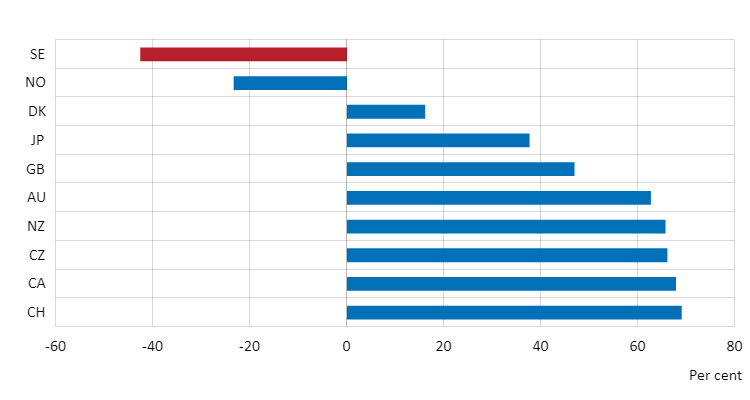
And look at this graph!

Change in the nominal cash volume. Countries with the lowest percentage increase of cash in circulation between 2009 and 2019.

Source: Armelius, H, Claussen, CA and Reslow, A (2020). “Withering cash: Is Sweden ahead of the curve of just special?” Sveriges Riksbank Working Paper Series No 393

The shift in consumer behavior is equally striking. The proportion of Swedes opting for cash transactions dwindled from 39% in 2010 to a mere 9% in 2020. This drastic reduction over the past decade underscores a significant change in the way Swedes perceive and utilize money.

However, despite the clear trend towards a cashless society, the Swedish government has not declared any intention to cease the production of notes and coins. For example, nations need cash to support the needs of the people in crises where the electrical grid goes down. Or for grandma to pay for groceries. Overall, it seems the farewell to cash is more a consequence of market forces and changing consumer preferences than a deliberate policy decision. Yet, the Swedish government has set digital goals for 2030, and is aiming to be at the forefront of digitalization.

Sweden has entered the realm of digital currencies with the e-krona pilot project. In its second phase in February 2021, the project explored the technical and legal aspects of a digital currency. Although no final decisions have been made, the project's progression indicates a potential future where digital currencies could replace physical cash. I would like to underline the stark reality that the expenses incurred in dealing with coins and notes vastly outweigh their utility.

Money, throughout history, has always adapted to the needs of society. Shifting from shells to metal coins, paper notes, and now digital numbers. As we look at what’s going on with money, we need to understand the roles money plays:

1. help us compare prices,

2. preserve its value over time,

3. be universally accepted.

The ongoing change in the financial landscape is merely a part of the transformation of society. We might fear change and hold tight to what has worked before, but the leather wallet is worn-out, and I can hardly remember what cash looks like anymore. Money will live in phones, watches, and in places we have not yet imagined. Cash is dead!

It’s obvious. In a digital world, digital money created by the government and cryptocurrencies operating on decentralized networks and free from government control are essential alternatives to cash. Certain cryptocurrencies may be seen as modern cash.

Sorry, grandma, the march toward a digital monetary landscape is not just a trend; it is the next chapter in the ongoing story of money's evolution.

Categories
Business & Society

Prominent Figures on Tokenization: What’s Stirring the Discussion?

It all began with a jpeg of a monkey and is poised to become a $5.6 billion market by 2025. We transitioned from monkey business to a broader tokenization movement. Tokenization, the process of converting rights to an asset into a digital token on a blockchain, has been hailed as a revolutionary force in the financial world. What do prominent figures in traditional finance and the cryptocurrency space think of tokenization?

Lucas Vogelsang: CEO and co-founder of Centrifuge

As far as I understand, Vogelsang sees tokenization as a game-changer, particularly for assets like art, real estate, and luxury items that are usually hard to buy or sell quickly. To him, it's not just about turning these things into digital versions but making them easier for everyone to own and trade. He believes that by using tokenization, we can make owning and investing in valuable things more open and accessible to everyone. It's like bringing a breath of fresh air to how we usually think about owning and investing in basically anything.

Adam B. Levine: CEO of Tokenly and founder of Let's Talk Bitcoin

When reading up on Adam's thoughts, it's clear that Levine highlights how tokenization can be a real game-changer for people using money. He believes it has the potential to make more people adopt new types of currencies and completely change how money works. To him, tokenization isn't just a fancy term – it's like a spark that can make money move around more freely and be used in lots of different ways.

Bill Gates: Guess what company he represents!?

According to Gates, tokenization isn't just tech jargon – he views it as a useful tool that can make payments better for everyone. He's interested in how this tech could make payments safer, faster, and more personalized, especially when it comes to public services.

Ravi Menon: Managing Director of the Monetary Authority of Singapore

In Menon's paper, "Making Sense of Crypto," he talks about how tokenization can break down big things into smaller pieces, making it easy and safe for people to trade without using middlemen. To him, it's like opening a door to finding new value in different parts of the economy that we haven't explored much before.

Raoul Pal: Founder of Global Macro Investor and Real Vision

Pal, a former executive at Goldman Sachs, is optimistic about tokenization, particularly when it comes to NFTs. He paints a picture of a future where everything from contracts to cultural assets will be turned into digital tokens. According to Pal who is prominent in the crypto space, tokenization isn't just a small change – it's a massive shift in how businesses operate. Pal sees it as a golden opportunity for big brands to step into the world of Web3.

Yes, and Larry Fink from Blackrock likes tokenization.

To me, it’s clear that tokenization is grabbing the attention of the entire finance sector. Tokenization has the potential to reshape industries. What I hear in the crypto community is that it likely starts with the use of simple NFTs and gradually evolves into any kind of physical assets that can be tokenized. It’s a process that I understand will take years. However, as with any transformative technology, tokenization is not without its fears and critics. Firstly, there's no clear set of rules and regulations for tokenized assets, which can cause confusion and legal problems. Critics also worry that tokenization might not be transparent enough, making it unclear how much assets are really worth and how trading works. Another common concern is about security – since tokenization is still new, there's a risk of assets being hacked, leading to financial losses. But hey, that's the cryptocurrency industry in a nutshell at the moment…

In the eyes of an investor or as a societal phenomenon, the path of tokenization in finance is an unfolding story worth paying attention to.

Categories
Business & Society

How a Guy in Argentina Avoided Extreme Inflation with Cryptocurrency

Yes, you can do it too if you learn about cryptocurrencies. Navigating high inflation is one of the most prominent use cases for cryptocurrencies. Here’s how a tech-savvy guy in Argentina sidestepped a soaring 124.5% inflation.

I recently wrote about how Argentina has grappled with profound inflation and faced economic instability. As of now, President Javier Milei has not closed the Central Bank of Argentina. However, he has expressed his intention to do so, stating that the closure of the central bank is a "non-negotiable matter.” He has also made Bitcoin legal tender. Argentina is a prime example of how badly cryptocurrencies are needed in some countries.

In August 2023, Argentina reached its highest annual inflation rate since 1991, soaring to 124.4%. What can you do as an ordinary person living in a country with such a bad economic situation?

Many people in Argentina prefer to keep their savings in U.S. dollars because it is seen as a stable and widely accepted currency. However, due to government restrictions and the official exchange rates not keeping up with the real market values, a black market for U.S. dollars has emerged. Imagine cash being so useless that a whole nation starts to exchange it into another currency. But this guy found another way.

Meet Mariano Conti, who is famous in the blockchain industry. His approach to navigating Argentina's high inflation was centered around adopting decentralized finance (Defi) strategies. Here's a breakdown of how he used cryptocurrencies to avoid the effect of inflation and live a normal day-to-day life.

Instead of receiving his income in the local currency or traditional forms, Conti told his employer he wanted to get paid in DAI. What’s that? MakerDAO is a decentralized finance platform on the internet that lets people create a stable digital currency called DAI. This currency always aims to be worth around the same as a US dollar, providing a reliable option for online transactions. It's useful because it offers stability in the often-volatile world of cryptocurrencies, making it a predictable choice for individuals and businesses.

Conti’s decision shielded him from the drastic fluctuations and devaluation experienced by the Argentine peso. At the time, inflation in Argentina was around 40%.

Conti used Ethereum Defi platforms to manage and grow his funds. He also converted a portion of his DAI earnings into pesos using a credit card to cover basic monthly expenses. This step allowed him to address immediate needs while preserving most of his income in a stable cryptocurrency. Afterall we still need to be a part of the traditional fiat system to live a normal life.

A portion of Conti's income in DAI was invested in various crypto assets through Defi platforms. Yes, this can be risky but please consider that a 40% inflation is absolute. Basically, he participated in lending and other financial activities within the crypto ecosystem and earned interest in a stable currency. His financial portfolio grew.

Conti had a strong belief in investing in the Ethereum ecosystem, but I would have invested in Bitcoin as a long-term investment strategy. What I am saying is that it’s possible to limit the effect of inflation and a faltering economic system with the use of crypto.

When I study how Conti used Ethereum Defi platforms to avoid inflation, it is striking how much knowledge one must have before we can easily use cryptocurrencies to fully use its potential. Firstly, Conti himself is an Ethereum developer with expert knowledge of the ecosystem. Of course, he would use it as much as possible considering Argentina's economic challenges. But anyone can do it, and a great deal has happened in the space since. Today, crypto is getting easier to deal with.

As I witness countries grappling with higher levels of corruption, political instability, and weak fiat currencies, the potential for wider adoption of cryptocurrencies is clear. Alternatives to traditional financial systems become a lifeline. After all, economic unpredictability is causing real-life human misery.

Categories
Business & Society

Soft Heart, Hard Tech: How Technology Can Redefine Humanity for a Better Tomorrow

It's not about the sophistication of gadgets or the complexity of blockchains; it's about the positive transformation they can bring to individuals and communities. We need to remind ourselves that technology is a tool—a means to an end, rather than an end in itself. So-called soft human aspects need to be in focus for technology to fully assist us. In today’s article, I clarify how technology should embrace soft-heartedness to assist us.

Inside the rabbit hole of Web3, I am struck by the nerdiness of it all. Chief Technology Officers and Web3 enthusiasts like myself seem to have found a parallel universe to spend our days basking in the sun of extraordinary technological achievements of the fourth industrial revolution. Watch out!

It's easy to lose sight of the core purpose of innovation. While technology serves as a catalyst for progress, its true essence lies not in the gadgets, algorithms, or networks, but in its potential to elevate human values, foster compassion, and create a better world. Its value transcends the realm of mere efficiency or convenience; it holds immense potential to amplify our human values, nurturing kindness, empathy, and soft-heartedness for the collective good of humanity.

In today's interconnected world, technology serves as a bridge, connecting people across distances. Yet, its deeper significance lies in fostering understanding, empathy, and meaningful connections beyond borders. Technology not only provides information and opportunities but also nurtures individual creativity, empowering people to pursue their dreams and aspirations. True innovation arises from a desire to solve problems and improve lives, addressing societal challenges and contributing to the well-being of all.

Recognize that technology is an enabler, and the real transformation lies in putting people first. Soft-heartedness is often overlooked in tech. We need empathy and kindness in tech to consider our humanity. Integrating these qualities into technology can transform how we design and use it. Imagine a world where technology prioritizes human values over profits, where empathy shapes development, ethics guide corporations, and users engage with mindful consideration for its impact. By aligning technological advancement with our core human values, we pave the way for a future where technology enriches lives, fosters empathy, and truly embodies our shared humanity.

So what do we need to watch out for?

Warning signs:

- Developers focus on making complex blockchain systems or apps without considering their impact on people's lives or communities.

- Health or mental health apps prioritize functions over offering real emotional support to users in need.

- Financial firms use advanced AI in Web3 without ensuring fair decisions, leading to biases based on race, gender, or money.

- Social media in Web3 lacks tools encouraging breaks or healthy conversations, disregarding the impact on mental well-being.

- Web3 innovations ignore eco-friendly practices, using harmful materials or creating energy-draining blockchain solutions.

- Web3 apps and devices overlook features for people with disabilities, excluding them from benefiting fully.

- Companies claim transparency using blockchain in Web3 but hide ethical problems or unfair work conditions.

- Web3 IoT devices lack strong privacy measures, putting personal data at risk due to insufficient security.

In these situations, there's a risk that Web3 technology might move away from values that prioritize people's well-being. It's crucial to steer technology towards empathy, ethics, and mindfulness for the benefit of individuals and society. Recognize that technology is an enabler, and the real transformation lies in putting people first.

Categories
Business & Society

Traditional Finance Bows to Bitcoin’s Momentum

In short, the crypto market is gaining significant momentum, and traditional finance seems to be relenting in its attempts to impede Bitcoin. Here's my analysis of the ongoing situation and what might occur next.

"You can't kill it," declared Jim Cramer on January 3, 2024. He's a former hedge fund manager and the host of CNBC's Mad Money, and he was referring to Bitcoin. Cramer's surprising shift from being highly critical of crypto to celebrating Bitcoin as a 'technological marvel' is noteworthy. His changed perspective highlights Bitcoin's unwavering resilience and underscores its potential impact within the financial sphere. While his show's viewership might be lower in today's declining traditional TV landscape, his change in stance serves as a metaphor for the shifting attitudes in traditional media and what's on the horizon. Historic developments are unfolding in the realm of crypto, with Spot Bitcoin ETFs on the horizon.

A Spot Bitcoin ETF aims to grant investors direct exposure to Bitcoin's current market price, similar to how the introduction of a gold ETF in 2004 revolutionized gold investments. This is why it's historic.

So, what exactly is a Spot Bitcoin ETF? It's a type of investment tool accessible in the stock market that enables easy investment in Bitcoin's current price movements. This opens the possibility for people to buy Bitcoin on Wall Street, and the anticipation within the crypto space for this is significant.

This groundbreaking financial instrument is on the brink of securing official approvals, as anticipated by Bloomberg Intelligence Analyst Seyffart, scheduled between January 8 and 10, 2024. People are buying! No, this is not investment advice. I am only giving you the overall feel of the market as I hear and understand things.

The overall vibe in the crypto space suggests an imminent shift in the investment landscape that could greatly influence investor sentiment and spur significant market interest. Yes, speculation is buzzing right now. Presently, only eight countries—Canada, Germany, Brazil, Australia, Jersey, Liechtenstein, Guernsey, and the Cayman Islands—have embraced Spot Bitcoin ETFs, and when the USA joins the team, substantial capital is expected to enter the market. Beyond mere price fluctuations, I've considered the potential societal implications if/when Spot Bitcoin ETFs gain approval.

This move is likely to act as a catalyst for broader institutional involvement in the cryptocurrency sector. The idea of having a regulated and easily accessible method to invest in Bitcoin, supported by the security and familiarity of traditional financial instruments, has attracted the attention of both institutional and retail investors. It signifies the maturing nature of the cryptocurrency market.

The crypto landscape is becoming sophisticated and mainstream. I've heard that major US players in traditional finance have purchased advertising space on television to promote Bitcoin. This holds significance as North America holds a substantial share of the global cryptocurrency market. According to a Chainalysis report, North America accounted for 24.4% of the total on-chain value received between July 2022 and June 2023, tallying approximately $1.2 trillion in global crypto transactions.

This is a significant moment, indicating a new era where cryptocurrencies are viewed as a serious and reliable investment option. The focus on Spot Bitcoin ETFs and North America's influential position in the crypto sphere signifies that more people are beginning to embrace and have faith in cryptocurrencies. I'd say cryptocurrencies are getting a stamp of approval. Moreover, as society increasingly acknowledges cryptocurrencies as credible assets, it could inspire businesses and industries to delve into utilizing blockchain technology for purposes extending beyond finance.

Categories
Business & Society

Beyond Price: Cardano’s Journey, Challenges, and Promises

I decided to dig deeper into my favorite cryptocurrency. Cardano's vision goes beyond technological innovation; it's about reshaping the fabric of our daily lives. Here we go.

Cardano began its journey in 2015 when a group of forward-thinking individuals, led by Charles Hoskinson, started working together. Hoskinson, who was involved in the early days of Ethereum, teamed up with other experts to create something new in the world of digital currencies. Their goal was clear: to build a better blockchain platform that could overcome the challenges faced by existing ones. They wanted to make a system that was more scalable, easier to govern, and sustainable for the long run. I would say that it's the beacon of a robust, trustworthy, and heartwarming crypto company.

The aura of the CEO, Charles Hoskinson, is a significant part of the strong Cardano community. He is like a 37-year-old-grandfather-genius on a libertarian mission. Being one of the first pioneers in the blockchain business, this blockchain platform is poised to revolutionize not just transactions but also the way societies interact, irrespective of geographical boundaries. The crypto industry generally considers Cardano a robust academic cryptocurrency, but in terms of price action, it has been boring for a few years. The lack of movement in terms of price has started a discussion about whether Cardano will wake up during the next year and a half or if holders of the coin will have to wait for some action until the next bull run. No one knows.

It’s considered a legitimate cryptocurrency but has a slight dark cloud circling above it. The Securities and Exchange Commission (SEC) is considering the possibility of categorizing ADA and similar tokens as securities. However, despite this consideration, the SEC hasn't taken any official action against Cardano's ADA token. Charles Hoskinson, Cardano's founder, believes that the SEC's actions toward crypto entities are more politically driven and not directly related to securities laws. Responding to the SEC's implication, IOG, the company behind Cardano's development, strongly disagrees, stating that ADA doesn't meet the criteria to be labeled as a security according to U.S. securities laws, historically or currently. I tend to agree with Charles as the SEC has mentioned that 68 cryptocurrencies are securities, without providing proof, only to scare investors and to hinder the US crypto industry. I digress.

Cardano is impacting several businesses and services across the world:

- Financial Services: EMURGO, a significant contributor to Cardano's growth, has successfully opened new avenues in financial services. Cardano’s platform's capabilities have been instrumental in creating opportunities within this sector.

- Global Supply Chain Management: Cardano's partnerships with companies such as Scantrust, Beefchain, and Baia’s Wine show its role in enhancing supply chain traceability, transparency, on a global scale.

- Retail, Healthcare, and Public Sectors: EMURGO's initiatives have extended to various sectors, including retail, healthcare, and public services, highlighting Cardano's adaptability across diverse industries.

- Internet of Things (IoT): EMURGO's involvement in IoT showcases Cardano's relevance in emerging technologies. Its integration into IoT solutions exemplifies its potential contributions to this advancing sector.

Cardano is global and strong in developing countries:

- Zanzibar, Africa: World Mobile Network subscribers in Zanzibar benefit from Atala for digital banking services, and Seso Global showcases properties for sale using Cardano on its website.

- Brazil: Collaborating with Petrobras, one of Latin America's largest corporations, Cardano has facilitated blockchain educational programs for its employees.

- Ethiopia: Cardano has been actively involved in developing a blockchain-based national ID system and partnering with the Ministry of Education to benefit millions of students and teachers.

What about the environment?

Cardano stands out among cryptocurrencies for its strong focus on sustainability. By using an innovative protocol called Ouroboros, it cuts down significantly on energy use, making it more eco-friendly. Its commitment to sustainable technology practices and managing growth while being environmentally conscious further emphasizes its dedication to sustainability. Through partnerships across different industries and adherence to evolving environmental rules, Cardano is an option for those seeking a greener choice in the world of blockchain.

Cardano has a very strong community across continents, and the platform fosters collaboration, democratizes decision-making, and sparks innovation within diverse communities. At least what I have heard...

It’s not all great!

The uncertainty around how regulators might classify its token ADA is a concern. It raises worries about legal compliance and potential barriers to development. Remember, cryptocurrencies are generally not finished products but constantly evolving and growing. Cardano's slower pace compared to some competitors makes me wonder about possible delays in essential features, affecting how investors perceive the platform and impacting confidence. But others have defended this pace, citing the platform's thoroughness and academic approach to research and development. Boring market performance has also affected my trust as an investor. Investors want some of that exciting crypto volatility. Furthermore, the success of upcoming upgrades outlined in the roadmap is crucial for Cardano's future, and any other cryptocurrency.

But I believe the technology of Cardano serves as a solid heartwarming crypto with potential for positive societal change.

Categories
Business & Society

The Biggest Human Dilemma for Happiness in the 4th Industrial Revolution

“Gratitude is not only the greatest of virtues but the parent of all others” said the Roman philosopher Cicero. It’s not breaking news that gratitude is vital for our happiness, yet why is it so hard to remain in a state of gratitude and not to be lured into the quest for more? It’s a human dilemma that we need to consider in the fourth industrial revolution where richness, information and matter is taking giant strives forward. Let’s dig into it.

The fourth industrial revolution has ushered in abundance across various realms. Innovations like smartphones revolutionized communication, while remote work, enabled by digital tech, provided flexibility, and widened talent pools. Not to mention advancements in AI and automation and robotics boosting efficiency in industries. The Sci-fi movie titled ‘Everything Everywhere Always At Once’ is a suitable metaphor for our existence. These advancements reflect the era's abundance, not only in communication and work but also in goods and technological innovations. We need to watch out!

Research is clear. Gratitude is associated with greater happiness, life satisfaction, well-being, and positive emotions. It helps people feel more positive emotions, relish good experiences, improve their health, deal with adversity, and build strong relationships.

But the human condition is often swayed by insatiable wants, perpetually seeking more in an alluring, and demanding endless quest for fulfillment. Gratitude, however, requires a shift in perspective—a conscious acknowledgment and appreciation for what one possesses.Subscribe

Basically, it’s about being conscious versus being unconsciously propelled by the customs of the culture we live in. The scarcity mindset ingrained within human nature often propels the perpetual chase for more, fueling a cycle that breeds discontentment. Grasping for material gains or achievements, the appetite for 'more' becomes insatiable, overshadowing the capacity to pause and reflect on existing blessings.

Gratitude, on the other hand, demands a departure from this endless pursuit, necessitating introspection and recognition of the present moment's richness. It requires humility, mindfulness, and an appreciation for the abundance already present in one's life.

The problem I have with remaining in gratitude is that it requires a shift in perspective which is naturally ingrained in our culture. It’s an arduous quest in a way that demands a reevaluation of values and a departure from societal conditioning that glorifies growth and attainment. Gratitude requires introspection and the need for more seems to go on autopilot. Gratitude is a practice that can be cultivated by anyone, regardless of their position in life, and it doesn't necessarily conflict with personal growth or ambition. However, I strongly feel that many individuals should increasingly embrace gratitude, especially considering the richness of today's society. Don't you agree?

The attainment of gratitude involves a deliberate effort to transcend the persistent desire for 'more' and embrace contentment with what one has. It necessitates a reevaluation of priorities and an appreciation for the vague facets of existence. Happiness often arises from the profound social contexts in which we live. However, love, relationships, and experiences are frequently overlooked or undervalued, as they often take a backseat to the pursuit of material acquisition or ego enhancement. Remember the ego is never happy. Not even millions in crypto is enough or 200 likes. You get the point. Love is particularly powerful in times of struggle or disaster, whereas in bad times the pursuit for more is meaningless.

It seems that gratitude is a virtue embraced by those who have reached a level of wisdom beyond the pursuit of meaningless achievements or have experienced suffering. But the thing is, gratitude is always here now. Its always within reach.