
Categories
Business & Society

Traditional Powers Reinforce Control in Cryptocurrency

Traditional Powers Reinforce Control in Cryptocurrency

A significant change is underway in crypto. As the cryptocurrency community celebrates the influx of approximately $500 million per day from traditional heavyweights investing in Spot Bitcoin ETFs, there's a crucial aspect being overlooked. Yes, Bitcoin is going to the moon but… prominent actors in the space are raising concerns about centralized control and the concentration of power. I agree.

Cryptocurrency has a strong freedom and equality theme to it. They are tools to challenge traditional banks and to make finance more accessible to everyone. However, the recent entry of established financial players has shifted the balance of power. These institutions bring with them their authority and influence, challenging the decentralized nature of cryptocurrency.

A key example of this shift is the popularity of stablecoins like USDT and USDC. While they offer stability to investors, they are tied to centralized entities and subject to regulations. As these stablecoins become the preferred choice for transactions, they give more power to their issuers, going against the decentralized principles of cryptocurrency.

The rise of Bitcoin ETFs also highlights the growing influence of traditional institutions. By bringing large amounts of Bitcoin under regulation, these products reintroduce centralization to a space built on decentralization. This concentration of wealth and decision-making in a few hands worsens existing inequalities and maintains the status quo. Let’s remind ourselves about the failing status quo. The current dominance of governments and institutions in regulating our financial affairs has demonstrated significant shortcomings.

As traditional institutions gain ground in digital finance, they reinforce their control over global financial systems, hindering efforts to create a fairer financial environment.

Brainiac and prominent figure in the crypto space, Charles Hoskinson, is raising warnings against sacrificing decentralization for short-term gains. He says that it's essential for stakeholders to stay vigilant against the increasing influence of traditional powers. He is speaking to the crypto community in general, but I am guessing most people do not care as billions are poured into Bitcoin. We’re all greedy.

Remember 1.7 billion people are still unbanked in the world, sending money is slow and expensive, inflation and mounting national debt is killing traditional currencies. Cryptocurrencies are more than a hype and speculation.

The solution!? Traditional finance does not need to be fully replaced by cryptocurrency, merely used as a hybrid solution where traditional finance is failing.


Categories
Business & Society

The IMF’s Bitcoin Critique: Hypocrisy Amidst Financial Turmoil

In the global finance debate, the International Monetary Fund (IMF) continues to express concerns about Bitcoin's potential to destabilize the financial system. Here, I address the glaring hypocrisy in this stance. As the IMF slanders Bitcoin, it conveniently overlooks the significant crises within the traditional financial markets.

Yes, the cryptocurrency space has problems. The IMF is quick to raise the issue of fraudulent practices and crashed exchanges such as FTX. Let me start by saying that not all cryptocurrencies are made equal and blaming an entire sector for a some rotten eggs and problems is like blaming dollar because criminals use it.

and let's face it… the traditional financial system has been no stranger to instability, with the Great Depression of the 1930s, the 1997 Asian financial crisis, the 2007-2008 global financial crisis, and the crisis during the COVID-19 pandemic serving as prime examples. These crises underscore the reasons Bitcoin could be a potential solution to many of the world's financial problems. Allow me to explain.

Many countries, especially developing economies, struggle with high levels of sovereign debt, which can lead to economic instability and crises. Banks have faced challenges such as bank runs, insolvency, and liquidity crises. Mismanagement, risky investments, and inadequate capital reserves have often been at the heart of banking sector instabilities. Both inflation and deflation represent significant challenges for traditional financial systems. Inadequate financial regulation, lack of transparency, and corruption have undermined trust in financial institutions and markets. 1.7 billion people globally lacks access to basic financial services. 1.7 billion individuals! It’s difficult to run a country in a globalized world as the global financial systems are interconnected. This means that issues in one region can quickly spread to others. We need help!

I would say that it’s obvious that the International Monetary Fund is wrong in raising concerns that Bitcoin could destabilize the financial system since traditional markets have been on a rollercoaster ride of uncertainty. The IMF's focus on Bitcoin's potential impact on stability is simply misplaced.

Traditional markets themselves are struggling to maintain their footing and Bitcoin can be viewed as way to solve many of the problems of the traditional financial system.

Traditional markets struggle to maintain stability, and Bitcoin offers a potential solution to many problems plaguing the traditional financial system. Regulatory loopholes and oversight failures have led to a series of high-profile scandals and market manipulations. Because of the way Bitcoin is set up, it's more transparent and harder to mess with, which could help address these problems in the traditional financial system.

While the IMF criticizes Bitcoin's energy consumption, it conveniently ignores the environmental toll of traditional financial activities. The carbon footprint of banks, trading floors, and cash production facilities is staggering, yet these issues often escape the scrutiny reserved for Bitcoin mining. If the IMF is truly committed to environmental sustainability, it should cast a critical eye on the entire financial ecosystem, not just Bitcoin. What’s more, as of 2024 we still do not know how much of Bitcoin energy consumption is in fact green energy. We need more research on the environmental issue.

The argument is straightforward, almost common sense. Rather than vilifying Bitcoin, the IMF should recognize it as part of the solution to a failing system. Traditional finance (tradfi) may cherish its control over money, but how many more crises are needed before we acknowledge the current system's flaws? The lifespan of fiat currencies is often cited as around 100 years, after which inflation and failing financial policies necessitate a reset. Just as there are useless cryptocurrencies, there are fiat currencies that have become nearly worthless, such as the Venezuelan Bolívar, Zimbabwean Dollar, and Argentine Peso, all of which have experienced hyperinflation.

The cryptocurrency space, and blockchain technology in particular, offers valuable lessons about money management and could revolutionize traditional financial practices. The transparency of the Bitcoin blockchain makes it difficult to conceal illicit activities, facilitates quicker and cheaper money transfers, and could aid hundreds of millions of people who are currently unbanked.

Instead of blaming Bitcoin, it's important for the International Monetary Fund (IMF) to recognize the shortcomings of the traditional global financial market and open their eyes in the fourth industrial revolution that we are experiencing. We now have technology to help the world and its citizens. Why not use it?

Categories
Business & Society

Bridging the Economic Divide: A Fresh Look at Bitcoin’s Role

Bridging the Economic Divide: A Fresh Look at Bitcoin's Role

Friends, we have a problem! In today's world, economic inequality is a growing concern, with a significant divide between the wealthy and the average citizen. I did some research and came across something called the "Cantillon Effect." Bear with me! After reading this article you will have a new perspective on money. Let’s dive into it!

This concept highlights how those closest to the creation of new money, like big banks and corporations, often get richer, while the rest of us feel the squeeze with slower wage growth and rising costs of living.

In principle, the traditional economic system and decentralized cryptocurrencies work in different ways.

Consider the aftermath of the 2008 financial crisis: governments and central banks around the world, particularly the U.S. Federal Reserve, pumped money into the economy to stabilize it. This process, known as quantitative easing, aimed to encourage lending and investment. Free money to the people might sound great! But here's the catch: the first in line for this new cash were the big banks and corporations. They enjoyed low borrowing costs and saw the value of their stocks and real estate soar. Meanwhile, average Joe faced stagnant wages and a slow recovery. This is called the Cantillon Effect, showcasing how those at the top benefit, while the rest lag behind.

Here's were Bitcoin, steps into the picture. Unlike traditional money, which central banks can create endlessly, Bitcoin has a finite supply. Do you remember that there's a cap of 21 million Bitcoins? Some say this makes Bitcoin even more scares than gold and I would agree. But more importantly, Bitcoin is decentralized. This means no single entity, such as central banks or an organization controls its creation or distribution, making it less prone manipulation and inequalities inherent in the traditional financial system. However, I would also like to raise a growing concern in crypto community regarding the decentralization of Bitcoin. Critics claim that major traditional financial players are gaining power over Bitcoin since the introduction of Spot Bitcoin Exchange-Traded Funds in the US. At time of writing $500 million of Bitcoin is bought every day by the likes of iShares Bitcoin Trust (IBIT), Fidelity Wise Origin Bitcoin ETF (FBTC), and Bitwise Bitcoin ETF (BITB). Yes, Blackrock is loving Bitcoin as well and the price of Bitcoin is increasing steadily. Bitcoin is on the same path as gold was in 2004 when gold was first offered as a ETF in the US.

Bitcoin offers a level playing field: anyone with internet access can participate in its economy, regardless of their location or status. Put differently, central banks can print traditional money out of thin air, but bitcoin has a limit, and everyone can get access immediately.

While Bitcoin alone won't solve all the issues of economic inequality, it represents a significant shift towards a more equitable financial system. By offering an alternative to the traditional banking system, it could help mitigate the effects of the Cantillon Effect, ensuring that the creation of new money benefits a broader segment of the population.

As I consider the role of Bitcoin in addressing economic inequality, I find myself at a crucial juncture. The Cantillon Effect sheds light on the inequalities in our current financial systems, where the privileged few benefits from the creation of money while others struggle with low wages and rising expenses.

Bitcoin offers hope by introducing a limited supply and a decentralized structure. However, concerns arise as it gains popularity, with worries about traditional financial players using influence over its direction. I think Bitcoin provides a chance for people to feel empowered, allowing anyone, no matter their background, to take part in a more equitable economy. While it won't fix every economic issue, it does move us closer to a fairer future.

Categories
Business & Society

Beyond the Hype: Blockchain’s Real-World Impact on Democracy

Beyond the Hype: Blockchain's Real-World Impact on Democracy

Data and information are everywhere, and we are only getting started. It's becoming too much and complicated. Here's reality: Every day, the internet sees more than 2.5 quintillion bytes of data being produced. This far exceeds what the largest libraries in the world can hold—in one day! The fourth industrial revolution that we are living in is clearly introducing new problems for humanity. Therefore, I say, as we advance technologically, we must also advance in our humanity.

Put simply, data is king, and those who hold it wield immense power. In a digital age where information is currency, who holds the keys, and how do we ensure fairness in its distribution?

Enter blockchain technology, a beacon of hope in our complex, data-driven landscape. This isn't just about a new way to do business or secure transactions; it's about reimagining our societal foundations. Blockchain challenges us to rethink privacy, governance, and equity, offering a glimpse of a world where information flows freely, yet securely.

Blockchain operates without the traditional gatekeepers—no banks, no governmental oversight. It's a radical departure from the norm, promising a shift in how power is distributed. At its heart, blockchain is a narrative of decentralization, a potential counterbalance to the monopolies that dominate our digital and physical realms. It's about democratizing power, ensuring that decisions and benefits are shared more equitably. Sounds good, right?

Yet, we stand at a philosophical crossroads. The promise of blockchain to level the playing fields and distribute power more evenly is profound. However, the quest for decentralization faces its own challenges. Just like water flows and finds its own path, power has a way of spreading out. Even in systems designed to share control evenly, there's a chance that power might just change shape and gather in new places, creating new leaders or entities with more control.

This paradox is central to our journey with blockchain. It forces us to ponder: Can true decentralization exist, or does it merely shift the epicenter of control? More fundamentally, can we, as a society, resist the urge to centralize power, even in systems designed to be leaderless?

Reflecting on this, we need to consider fundamental principles of democracy. The real measure of democracy is the extent of freedom and equality enjoyed by its weakest member. Blockchain stands as a testament to our collective aspiration for a fairer world. It embodies the hope for a system that transcends traditional power structures, where transparency and trust are built into the very fabric of our interactions. Yet, it also serves as a mirror, reflecting our deep-seated tendencies toward control and dominance.

In today's world, filled with new technology and data, it's important to remember that as we grow with technology, we should also grow in kindness and fairness. Technologies such as blockchain have the potential to make our systems more fair and open to everyone. However, the real success of these technologies will be judged by how much they improve the lives of those who have the least. This is a reminder that we should work to ensure the advantages of new developments are available to all, emphasizing that our progress as a community is truly shown by how we help our most vulnerable members.

Let's stay true to the values that help all of us. We should aim for a future where technology brings us together instead of splitting us apart; where the vast amounts of data and information are shared, open, and available to everyone. Data is humanity's treasure. By understanding the complex nature of blockchain, we might discover more than just a change in technology—we could see a restoration of human values. This could be a time where fairness, privacy, and working together are not just things we hope for.

Categories
Business & Society

Cryptocurrencies Ready to Sour

Cryptocurrencies Ready to Sour

As we step into 2024, the world of cryptocurrencies has (almost) become a global sensation. We are still in the early stages of global crypto adoption, but a great deal has happened. Multiple factors have been making cryptocurrencies more appealing and accessible to the public. Let’s delve into it.

When I researched this article, I was struck by how many factors need to align before crypto gains full approval from the public. I know many people still think it’s a scam, and sometimes they are right. But this article focuses on the societal changes that have already taken place to popularize cryptocurrencies.

A major hurdle that cryptocurrency faced was the uncertainty surrounding its regulations. However, recent developments have brought much-needed clarity. The approval of a Bitcoin Spot ETF by the U.S. Securities and Exchange Commission and the introduction of the Markets in Crypto-Assets (MiCA) regulation in the European Union have created a more regulated and legitimate environment. Nowadays, institutions and everyday investors are active in the space. Just a few years ago, the crypto community dreamt of this development. And there is more…

In 2024, crypto enthusiasts are eagerly awaiting the Bitcoin halving event set for April. This is like spring break for crypto enthusiasts. The Bitcoin halving is a process that reduces the rate at which new Bitcoins are created, occurring approximately every four years. The crypto space can't wait for the party. As demand for Bitcoin continues to rise, driven by its newfound status as a store of value, this reduced supply could potentially push up its market price.

Crypto is now considered a diversification asset, and I hear that fund managers are recommending investors allocate 1-2 percent of their portfolio to Bitcoin. Imagine what that means for an asset that is not even worth 1 trillion yet. I hear that big stock exchange brokers are considering Bitcoin an attractive option for those seeking to diversify their investment portfolios.

The participation of major financial institutions in the cryptocurrency space has been a game-changer. The likes of BlackRock and Fidelity filing for Bitcoin ETFs send a clear signal of the growing acceptance of cryptocurrencies as a legitimate asset class. Cryptocurrency has suddenly become a credible asset and more accessible to mainstream investors.

Incidents of security breaches and fraudulent activities have become less frequent, a welcome development in the space.

Furthermore, Bitcoin has emerged as a hedge against inflation and political upheaval. Individuals in conflict-stricken countries are turning to cryptocurrencies to protect their assets and financial independence. It’s money, you know.

The future looks bright for cryptocurrencies as an efficient option for international transfers, eliminating intermediaries and reducing fees. Banks are turning to crypto to transfer money. The integration of cryptocurrencies with existing banking systems and payment platforms has made them more user-friendly and convenient.

Efforts to educate the public have played a crucial role in fostering adoption. I also have something fresh in the works. Stay tuned, dear reader.

Yes, there are problems in the space. Plenty of them. But crypto has grown.

Cryptocurrencies are like a young bird perched on the edge of its nest, poised to take its first flight into the sky.

Categories
Business & Society

Mastering Market Turbulence: The ‘Steel Hands’ Strategy

In crypto, fortunes can be made or lost in an instant. Here’s a nuanced perspective on investing that is interesting for those seeking financial success while also considering the impact on overall well-being. I present the "steel hands" approach, a strategy that aims for a delicate equilibrium between risk management and mental health.

The first strategy in investing is shaky and tough on our mental health. The "paper hands" strategy, characterized by impulsive selling and low-risk tolerance, provides a shield against steep losses during market downturns. However, the emotional roller coaster of fear and uncertainty associated with this approach can take a toll on mental health. Studies suggest that impulsive actions driven by fear are linked to long-term negative outcomes, highlighting the potential psychological impact. Word in the crypto community is that this strategy usually leads to losses as it's nearly impossible to perfectly time the market. I hear that “time in the market” is better than “timing the market.”

On the other end of the spectrum, the "diamond hands" strategy represents unwavering commitment, showcasing resilience even in the face of extreme market volatility. While this approach may result in long-term gains, maintaining such steadfastness requires a significant psychological toll, potentially affecting overall well-being. This strategy is for hardcore believers in crypto and is only appropriate for investing in solid cryptocurrencies. You know, the top one! The problem with this strategy is that it can mean that one never takes profit and only experiences the ups and downs of the crypto market.

Now, consider the "steel hands" approach, a strategy offering a more balanced and sustainable path. I did some research and found a study from the Journal of Behavioral Finance, titled "The Impact of Risk Tolerance on Investment Decisions: Evidence from the Chinese Stock Market" by Y. Zhang, Y. Li, and Y. Wang, that underscores the importance of maintaining a balanced approach to risk management. It’s common sense research; when considering our mental health in trading, it's smart to be balanced and take a moderate risk. I would add, that may also be smart in terms of cryptocurrency investing as this asset class is highly volatile and risky. But hey, I am not an investment advisor and not as knowledgeable as those guys at the bank …

Investors with "steel hands" possess a moderate risk tolerance, balancing investments across different asset classes and sectors. As the FOMO-force in crypto is strong, I would say that this strategy is a commonsense approach to investing. For those new to crypto, FOMO is a strong feeling that we must buy immediately along with everyone else. Generally I hear that we want to do the opposite.

Whereas the “steel hands strategy” allows for a more thoughtful and well-considered decision-making process, steering clear of impulsive actions. The study also emphasizes that this balanced approach aids in avoiding irrational decision-making and maintaining focus on long-term financial goals.

Here's a practical example. Imagine an investor faced with a sudden market downturn. A person with "paper hands" might panic, hastily selling off assets to avoid potential losses. Conversely, an individual with "diamond hands" would likely hold onto their investments, convinced of long-term success but enduring increased stress.

Now, envision an investor with "steel hands" in the same scenario. With a moderate risk tolerance, this individual would navigate the downturn with resilience, holding onto assets but also being open to strategic adjustments based on rational analysis. This balanced approach not only allows for potential gains but also contributes to a healthier mental state. Daily swings in prices will not impact as much and one can even ignore daily statistical analysis or astrology to guess the future price of an asset. Yes, there are those that predict cryptocurrency prices through astrology…

If you learn anything from this article, it is to stay away from having paper hands. Please do not jump from coin to coin or from stock to stock thinking that you are smarter than the market.

Here’s some sobering data: Day trading, a risky strategy in the financial world, faces considerable hurdles, as highlighted by several studies. A study in the Journal of Finance found that only 1% of day traders consistently make profits. Another study by Charles Schwab showed that while 70% of day traders have a game plan, only a small portion of them actually end up making money. In a more extensive study called "Day Trading For A Living," which tracked 1,600 Brazilian day traders for over a year, only 13% were still actively trading after three years. Moreover, official data from 30 ESMA-regulated brokers disclosed that, on average, a high 74.9% of forex traders incur financial losses, emphasizing the substantial risks linked with day trading.

If you decide on investing in crypto, “Do not day trade.” Just don’t.

Categories
Business & Society

Bitcoin ETF Showdown: How Lower Fees Are Shaking Up Traditional Finance Giants

The world’s biggest traditional financial players are in a tussle over Bitcoin, and investors are opting for the most cost-effective fund. I became curious about the impact on Bitcoin's price following the celebrated approval of the Spot Bitcoin ETF in the USA. Why did the price dip despite major asset management firms injecting billions into the asset? Here’s the lowdown.

In brief, Grayscale Bitcoin Trust (GBTC), a key player since 2013, faces challenges due to its higher fees, while IBIT, linked with the influential BlackRock, is gaining traction with its lower charges. GBTC strategically offloaded a significant amount of Bitcoin after the Spot Bitcoin ETF launch, causing the price to drop. Meanwhile, the top nine traditional financial giants traded Bitcoin for over $5 billion in the initial 4 days. BlackRock's IBIT is swiftly amassing Bitcoin and might surpass Grayscale's holdings soon.

In simpler terms, investors prefer the more economical Bitcoin fund and are flocking to it.

Considering that the world's largest asset manager, BlackRock, is fully embracing Bitcoin is arguably the most significant vote of confidence for Bitcoin since certain nations adopted it as legal tender. Presently, the Central African Republic and El Salvador have embraced Bitcoin as legal tender, and Argentina is moving towards legalizing its use in specific contexts.

My takeaway is that the intricate relationship between major traditional finance players and their offerings makes predicting asset prices challenging. I didn't hear experts mentioning GBTC before the Spot Bitcoin ETF approval. No, the crypto space didn't anticipate a downward price trend for Bitcoin after the ETF approval. Well, I only heard that it could be a possible sell the news event, but nothing to substantiate the claim.

However, the space is screamingly optimistic about Bitcoin, especially after the recent ETF approval saga. But. people in the crypto community are bored of the constant chatter about Bitcoin ETFs. Me too. But now you're in the loop.

Categories
Business & Society

Cash is Not King, Cash is Dead in Sweden

In the heart of Scandinavia, the land with four dramatic seasons, grandma is crying. Sweden has bid farewell to an age-old companion – cash. The evolution towards a cashless society has been swift. Nowadays, cash represents only 1% of the GDP. It’s fair to say, “cash is not king, cash is dead”. The only one that cares is grandma!

As early as 2016, Swedish banks acknowledged that the costs associated with handling physical money far exceeded its benefits. Basically, cash is too expensive.

The decline in the use of cash is vividly reflected in the numbers. The share of cash in Sweden's GDP shows a consistent downward trend, plummeting to a mere 1% of the GDP. This stands in stark contrast to other countries, such as those in the eurozone, where cash still constitutes nearly 10% of the GDP.

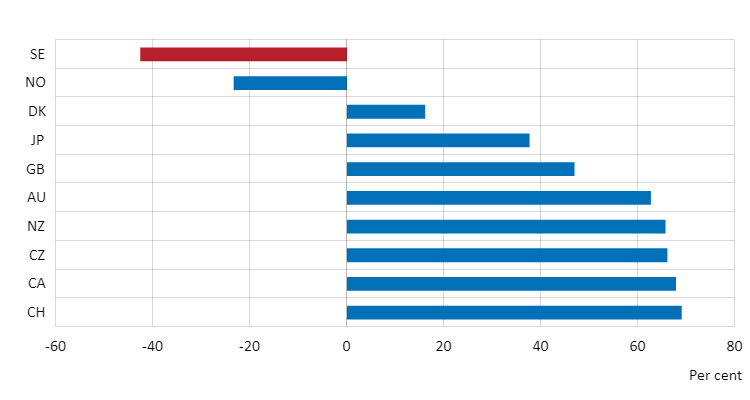
And look at this graph!

Change in the nominal cash volume. Countries with the lowest percentage increase of cash in circulation between 2009 and 2019.

Source: Armelius, H, Claussen, CA and Reslow, A (2020). “Withering cash: Is Sweden ahead of the curve of just special?” Sveriges Riksbank Working Paper Series No 393

The shift in consumer behavior is equally striking. The proportion of Swedes opting for cash transactions dwindled from 39% in 2010 to a mere 9% in 2020. This drastic reduction over the past decade underscores a significant change in the way Swedes perceive and utilize money.

However, despite the clear trend towards a cashless society, the Swedish government has not declared any intention to cease the production of notes and coins. For example, nations need cash to support the needs of the people in crises where the electrical grid goes down. Or for grandma to pay for groceries. Overall, it seems the farewell to cash is more a consequence of market forces and changing consumer preferences than a deliberate policy decision. Yet, the Swedish government has set digital goals for 2030, and is aiming to be at the forefront of digitalization.

Sweden has entered the realm of digital currencies with the e-krona pilot project. In its second phase in February 2021, the project explored the technical and legal aspects of a digital currency. Although no final decisions have been made, the project's progression indicates a potential future where digital currencies could replace physical cash. I would like to underline the stark reality that the expenses incurred in dealing with coins and notes vastly outweigh their utility.

Money, throughout history, has always adapted to the needs of society. Shifting from shells to metal coins, paper notes, and now digital numbers. As we look at what’s going on with money, we need to understand the roles money plays:

1. help us compare prices,

2. preserve its value over time,

3. be universally accepted.

The ongoing change in the financial landscape is merely a part of the transformation of society. We might fear change and hold tight to what has worked before, but the leather wallet is worn-out, and I can hardly remember what cash looks like anymore. Money will live in phones, watches, and in places we have not yet imagined. Cash is dead!

It’s obvious. In a digital world, digital money created by the government and cryptocurrencies operating on decentralized networks and free from government control are essential alternatives to cash. Certain cryptocurrencies may be seen as modern cash.

Sorry, grandma, the march toward a digital monetary landscape is not just a trend; it is the next chapter in the ongoing story of money's evolution.

Categories
Business & Society

Prominent Figures on Tokenization: What’s Stirring the Discussion?

It all began with a jpeg of a monkey and is poised to become a $5.6 billion market by 2025. We transitioned from monkey business to a broader tokenization movement. Tokenization, the process of converting rights to an asset into a digital token on a blockchain, has been hailed as a revolutionary force in the financial world. What do prominent figures in traditional finance and the cryptocurrency space think of tokenization?

Lucas Vogelsang: CEO and co-founder of Centrifuge

As far as I understand, Vogelsang sees tokenization as a game-changer, particularly for assets like art, real estate, and luxury items that are usually hard to buy or sell quickly. To him, it's not just about turning these things into digital versions but making them easier for everyone to own and trade. He believes that by using tokenization, we can make owning and investing in valuable things more open and accessible to everyone. It's like bringing a breath of fresh air to how we usually think about owning and investing in basically anything.

Adam B. Levine: CEO of Tokenly and founder of Let's Talk Bitcoin

When reading up on Adam's thoughts, it's clear that Levine highlights how tokenization can be a real game-changer for people using money. He believes it has the potential to make more people adopt new types of currencies and completely change how money works. To him, tokenization isn't just a fancy term – it's like a spark that can make money move around more freely and be used in lots of different ways.

Bill Gates: Guess what company he represents!?

According to Gates, tokenization isn't just tech jargon – he views it as a useful tool that can make payments better for everyone. He's interested in how this tech could make payments safer, faster, and more personalized, especially when it comes to public services.

Ravi Menon: Managing Director of the Monetary Authority of Singapore

In Menon's paper, "Making Sense of Crypto," he talks about how tokenization can break down big things into smaller pieces, making it easy and safe for people to trade without using middlemen. To him, it's like opening a door to finding new value in different parts of the economy that we haven't explored much before.

Raoul Pal: Founder of Global Macro Investor and Real Vision

Pal, a former executive at Goldman Sachs, is optimistic about tokenization, particularly when it comes to NFTs. He paints a picture of a future where everything from contracts to cultural assets will be turned into digital tokens. According to Pal who is prominent in the crypto space, tokenization isn't just a small change – it's a massive shift in how businesses operate. Pal sees it as a golden opportunity for big brands to step into the world of Web3.

Yes, and Larry Fink from Blackrock likes tokenization.

To me, it’s clear that tokenization is grabbing the attention of the entire finance sector. Tokenization has the potential to reshape industries. What I hear in the crypto community is that it likely starts with the use of simple NFTs and gradually evolves into any kind of physical assets that can be tokenized. It’s a process that I understand will take years. However, as with any transformative technology, tokenization is not without its fears and critics. Firstly, there's no clear set of rules and regulations for tokenized assets, which can cause confusion and legal problems. Critics also worry that tokenization might not be transparent enough, making it unclear how much assets are really worth and how trading works. Another common concern is about security – since tokenization is still new, there's a risk of assets being hacked, leading to financial losses. But hey, that's the cryptocurrency industry in a nutshell at the moment…

In the eyes of an investor or as a societal phenomenon, the path of tokenization in finance is an unfolding story worth paying attention to.

Categories
Business & Society

How a Guy in Argentina Avoided Extreme Inflation with Cryptocurrency

Yes, you can do it too if you learn about cryptocurrencies. Navigating high inflation is one of the most prominent use cases for cryptocurrencies. Here’s how a tech-savvy guy in Argentina sidestepped a soaring 124.5% inflation.

I recently wrote about how Argentina has grappled with profound inflation and faced economic instability. As of now, President Javier Milei has not closed the Central Bank of Argentina. However, he has expressed his intention to do so, stating that the closure of the central bank is a "non-negotiable matter.” He has also made Bitcoin legal tender. Argentina is a prime example of how badly cryptocurrencies are needed in some countries.

In August 2023, Argentina reached its highest annual inflation rate since 1991, soaring to 124.4%. What can you do as an ordinary person living in a country with such a bad economic situation?

Many people in Argentina prefer to keep their savings in U.S. dollars because it is seen as a stable and widely accepted currency. However, due to government restrictions and the official exchange rates not keeping up with the real market values, a black market for U.S. dollars has emerged. Imagine cash being so useless that a whole nation starts to exchange it into another currency. But this guy found another way.

Meet Mariano Conti, who is famous in the blockchain industry. His approach to navigating Argentina's high inflation was centered around adopting decentralized finance (Defi) strategies. Here's a breakdown of how he used cryptocurrencies to avoid the effect of inflation and live a normal day-to-day life.

Instead of receiving his income in the local currency or traditional forms, Conti told his employer he wanted to get paid in DAI. What’s that? MakerDAO is a decentralized finance platform on the internet that lets people create a stable digital currency called DAI. This currency always aims to be worth around the same as a US dollar, providing a reliable option for online transactions. It's useful because it offers stability in the often-volatile world of cryptocurrencies, making it a predictable choice for individuals and businesses.

Conti’s decision shielded him from the drastic fluctuations and devaluation experienced by the Argentine peso. At the time, inflation in Argentina was around 40%.

Conti used Ethereum Defi platforms to manage and grow his funds. He also converted a portion of his DAI earnings into pesos using a credit card to cover basic monthly expenses. This step allowed him to address immediate needs while preserving most of his income in a stable cryptocurrency. Afterall we still need to be a part of the traditional fiat system to live a normal life.

A portion of Conti's income in DAI was invested in various crypto assets through Defi platforms. Yes, this can be risky but please consider that a 40% inflation is absolute. Basically, he participated in lending and other financial activities within the crypto ecosystem and earned interest in a stable currency. His financial portfolio grew.

Conti had a strong belief in investing in the Ethereum ecosystem, but I would have invested in Bitcoin as a long-term investment strategy. What I am saying is that it’s possible to limit the effect of inflation and a faltering economic system with the use of crypto.

When I study how Conti used Ethereum Defi platforms to avoid inflation, it is striking how much knowledge one must have before we can easily use cryptocurrencies to fully use its potential. Firstly, Conti himself is an Ethereum developer with expert knowledge of the ecosystem. Of course, he would use it as much as possible considering Argentina's economic challenges. But anyone can do it, and a great deal has happened in the space since. Today, crypto is getting easier to deal with.

As I witness countries grappling with higher levels of corruption, political instability, and weak fiat currencies, the potential for wider adoption of cryptocurrencies is clear. Alternatives to traditional financial systems become a lifeline. After all, economic unpredictability is causing real-life human misery.